Wednesday, September 12, 2007

Merigail Circa 1980

As promised at both the 365 days project and in my previous post here, I am presenting a short tape sent to me by one of Merigail Moreland's relatives, featuring five songs she recorded around 1979 or 1980, when she was have been in her mid to late 30's. For me, her performances here lack the spark, verve and pure joy of life that radiates from the earlier recordings. In addition, I don't really find the songs or the backing arrangements to be very interesting (with a few exceptions). However, in order to complete the picture, to honor the requests made, and also because others may enjoy these as much as the earlier tracks, I am including these tracks here. 

The best two songs, in my opinion, are versions of "Both Sides Now": 

Play:   

And "Can't Take My Eyes Off of You": 


Also on the tape were versions of a song called "The Joker": 


And a song previously recorded by Barbra Streisand, "Why Did I Choose You?": 


The tape actually begins with this song, but as I find it the weakest, in recording quality, in performance, and particularly as a song (an abysmal song - what else would one expect from the mind of the execrable Bobby Goldsboro?) So I've included it last. It is called "With Pen in Hand": 

Perhaps there are yet more recordings to be heard, and if so, I'll be happy to share them here!

Monday, September 10, 2007

More Merigail

After my recent post to the 365 project, of a bunch of Merigail Moreland material, there were several requests that I post the rest of what I own of this wonderful singer. I'm going to do this in two posts, each containing multiple tracks. 

First up are three tracks that I skipped in submitting to the 365 days project, because I was unsure that they actually are Merigail. However, the more I listen to them, the more convinced I am, due to the little flip in her voice near the end of two of these three tracks. These are, however, the least of the tracks I am offering up today, in terms of quality, and I would guess that they predate the "Reputation" tapes from 1953 by at least some months, if not more, based on the (lack of) quality of her singing. 

First, she sings a song called "Why", a song her father appears to have been trying to turn into a hit (based on the number of versions of it that turn up on these tapes), presumably with her father, and perhaps the woman who joins in later is her mother:

Play:  

Next, she sings the previously heard (at 365 days) "Mommy Daddy Bye Bye" again with a man I'm assuming is her father, Don: 


Then she sings "Why", again, this time with an unidentified woman, probably the same woman as in the earlier version: 

Play:  

Next up is a third version of "Head Cheese", which I left out of the 365 days post because it seemed sort of redundant. This is from the same recording session as the second of the two versions posted to 365: 

Play:  

The main focus for today, however, is the other 1953 versions of Reputation, which I left out of my post because there were just so many of them. Here we have the first recorded version with the guitarist, who appears to be still learning his part: 

Play:  

Next up, another take, one which came before the "you were sharp" version that I've already shared. Oddly, Don shouts "perfect" at the end of this take, although it quite clearly was not so perfect: 


Here is a tiniest fragment of a take, included for completests:


And here is a version actually recorded after the "final 1953 version", but apparently rejected in favor of the better version done just before this one: 


And I believe that with the tracks featured here, I have now shared, between here and at WFMU, everything that is heard on the 1953 (and pre-1953) Moreland tapes which features Merigail's voice. 

After ten years, these recordings can still make me tear up more than just a bit. Her voice connects with me on some very basic level, the joy of a child combined, at times, with the abilities of a great singer in training. I love every minute of these tapes. 

Tonight's project is to digitize the circa 1980 tapes of Merigail which I was sent recently, and I hope to have those posted tomorrow.

Friday, August 10, 2007

I Won't Always Love a Cake of Ice

Listening to a new 45 aquisition this evening with a friend, I was reminded of a somewhat similar 45 from the same era, a bubbly b-side obscurity from 1954 by the trio of Don, Dick and Jimmy, called "You Can't Have Your Cake and Eat It, Too", on Crown Records. 

There's a lot to like in this goofy little number. The close, perfectly executed harmonies, and the swingin' backing, especially as it really kicks in at the start of the second verse.

But I actually get the biggest kick, as is often the case, out of one of the smallest moments. Each time the three part harmony returns, during a verse, with the word "listen", there is something irresistible about the voice of the guy with the top harmony. He doesn't sound quite like this anywhere else in the song, either in vocal tone or the way he says the words, and it really catches my ear every time. 

Quite a fun little record! 

Play:

Thursday, August 02, 2007

You Know How Soft It Can Be

I may be virtually alone in this preference, but "The Ballad of John and Yoko" has been on my list of the best half-dozen Beatles songs for as long as I've been listening to the Beatles. At times, I've listed it as my favorite of the entire Beatles canon. 

So how could I possibly fail to share with the assembled multitude this first rate cover version of this wonderful tune, performed, of course, by The Percy Faith Strings.

Play:

Wednesday, August 01, 2007

Who Was He?

Several years ago, I went through a short period of time during which I came across a bunch of Scandinavian related 45's and 78's that I really really liked. These were all dance records, in most cases made by American descendants or perhaps immigrants. My favorite of these, "The Norway Rhinelander" has already been posted here, well over a year ago. 

But a close second would be a recording with a more roundabout story. At some point during that phase, I found a 45 with a curious title. It read "Johan Pa Snippen". That wasn't the curious part. The subtitle, presumably a translation, read "The Jazz Farmer". (That was the curious part.) 

It was quite enjoyable, and I played it a bunch of times, put in o a mix tape, and moved on to whatever came next. Around that time, I came across an estate sale-sized batch of reel to reel tapes recorded by a reel/real pack-rat, someone who recorded just about anything and everything off the radio and kept detailed notes of every last recording, sometimes dozens of separate recordings on one reel. 

I was listening to one of these, which featured the sound from about 10 minutes of a local Chicago TV show called "International CafĂ©". Coming out of applause for one performance, I heard a familiar melody, followed by some fairly hyperactive singing in Swedish. Near the end of the performance, I realized that it was "Johan Pa Snippen", and was rewarded for my close attention when the announcer indicated that I was correct. 

As far as I can tell, he identifies the singer as "Siggy Furst", but I could be wrong on the spelling and prounouciation of both names. Regardless, this is a recording that I find completely infectious, more than 15 years after I first heard it. The energy in the singer's performance is wonderful, and, well, I love this sort of instrumental performance anyway. 

Who was Siggy Furst? Darned if I know. What is he singing about? A Jazz Farmer? What is a Jazz Farmer? Anyone who can translate this is certainly more than welcome to offer up the translation!

Play:  

ADDENDUM, 2021: The correct spelling of the singer's name, as seen in the linked song, is Sigge Furst. I subsequently got a good copy of this song (which I'd originally had only as a poor over-the-air recording from a TV show), and it is that version that is linked here. Also, after I learned more about him (from the comments responding to this post!), I did a much larger post about this song at WFMU, which you can find here


Tuesday, July 31, 2007

HE'S CUT-UP GOOD!!!

A friend of mine recently posted one of his montages of sound to his site, so I thought I'd put up a few of my "Cut-Up" tapes. 

It's sort of funny, but back when I had to do these "cut-ups" with the pause button on a cassette recorder (along with another cassette player, a record player and a reel to reel), I made these tapes all the time - hours of them. Since having access to computers and programs which might make this sort of thing easier, I've made about a dozen mash-ups and a total of two of these sorts of cut-ups. 

Today, I'm putting up a link to one cut-up of Harry Belafonte's masterful "Jamaica Farewell", that I particularly like, and another one of "King of the Road" by Roger Miller, which is almost as good. I typically only sliced up records I really like, not having the stomach for learning to know records I don't like well enough to effectively cut them up. My style was the random word replacing the perfectly normal lyrics of the original song. Some of these inserts may be familiar to you, others are from private recordings in my collection. A few of them are in questionable taste. 

Each of these reconfigurations of popular songs were done over 25 years ago. I hope you enjoy them.

Play:  


ADDENDUM, 2021: I actually don't know which versions of these two songs I originally shared - I did "cut-ups" of each of them multiple times, but I think I have the right ones. 

I think I planned to feature more of these as the weeks and years went by, but with the exception of a couple of Mash-Ups, I never did. If anyone is interested, I still have all the old tapes, and they are digitized, and I could share more. While I enjoy the above two, there are a bunch that are much better. 

Saturday, July 28, 2007

My New Favorite Record

I first heard this song about four months ago, and since then, it's sometimes seemed like it's the only thing I've been listening to ever since. It's called "What's She Got (That I Ain't Got?) and it's by Betty Jayne.

This is a song-poem record, as far as I can tell (NOTE: See addendum below), but it's unlike just about any I've ever heard. The amount of arrangement and planning that must have gone into this record amazes me, as do a lot of other features of the recording.

Where to begin? The insane amount of echo? The sparse instrumentation, featuring a guitarist who clearly has spend hours on end listening to "Love is Strange"? The key change in the middle? The complex (for a song-poem) backing vocals, sometimes singing oohs and aahs, in three part harmony in spots, sometimes singing the lyrics to the song in harmony with the lead? The violin (!!) that pops out of nowhere to lead into the first bridge? 

Those are all great. In fact, there's not a moment of this record that I don't adore, even after dozens of listens. But a few things stand out. First are the lyrics. I expected a song with this title to be a whine, or at least something of a pouty complaint. But instead, they contain an indignant challenge, not just about the singer's qualities in comparison with the current girl, but also the good points of countless other girls, too:

"Her hair is blonde, with natural curls, but so is mine, and a lot of other girls'"

In other words, 'this girl you're with, she's okay and all, but there are PLENTY of other girls you'd like better, not just me'. (I know it's not a good thing that all of the comparisons made are with regard to looks and kissing ability, but such was the era...)

The writer was Edith Hopkins, who went on to establish her own song-poem label, using many of those who are today the best known names in the field from that era, and I have yet to hear one of her songs that hasn't been far above average for this genre. In fact, my guess is she wrote the words and music to her songs, and used the song-poem teams as hired help for her demos.

In this case, she got a perfect singer for the job, and that's perhaps the biggest reason I can't do without this record. Betty Jayne, whoever she was, sells this song like every word of it rings true to her. She's got me sold! If I was around, back then, and she was singing this to me, I'd probably think twice about her challenge, and then another six or eight times. Her inflection for the line "Sugar Sweet and Pepper Hot" is unbelievably sexy.

Saving the best for last, there is a moment in this song that transcends just about everything else, where all of the above adds up to 15 seconds of music I never want to be without again. It's the first bridge, starting at about the 33 second point, with that violin mentioned above. The backing vocals kick in, just short of sounding out of control, Betty ups the challenge with an irresistible vocal, and the guitarist goes to town. I find this segment of music as intoxicating as anything I've ever heard.

Hope you enjoy it at least half as much as I do, and perhaps quite a bit more!

Play:  

ADDENDUM, 2021: After living with this record for 14 years, hearing from Edith Hopkins' family, and learning more about her career, it's now clear to me that this record was not a song-poem effort, and was at the worst a vanity release, and more likely an actual attempt at producing a hit record. I won't go into all the details here, but although Edith Hopkins did later engage song-poem companies, her releases, especially the early ones such as this one, are not song-poems in the traditional sense, and in this case, not at all. 

Also, I have never for a moment fallen out of love with this record. I think  it's one of the half dozen greatest singles ever released. The b-side is great, too. 

Saturday, July 22, 2006

A Few Pieces of Driftwood

Jimmie Driftwood was a middle-aged Arkansas schoolteacher who, among other things, had been adapting and rewriting old songs, as well as writing original music, about American history, to help his students learn not only about America, but to love its history and the study of history. 

I'm not sure in which order these things happened, but Driftwood's life got much more interesting when one of his songs attracted enough to lead to a contract with RCA records and result in a cover version of that song by an up-and-coming country singer named Johnny Horton. That song, The Battle of New Orleans, went on to become one of the biggest hits of the late 1950's, hitting number one for six weeks in 1959. 

As much as I love that record (and all of Horton's tragically few hits), Jimmie Driftwood's records are great on another scale entirely. Accompanying himself with the distinctive sound of his homemade guitar (along with a few other instruments), and his equally distinctive voice, Driftwood sang with an honesty and directness I'd love to hear on records these days. 

Today, I've uploaded two of my favorite examples from his many albums (at least seven that I know of, released from 1959-66 or so). The first "Rattlesnake Song" tells a familiar folk tale, of the lover saving her beloved from a deadly bite by sucking out the poison. 

However, in this case, the song is rendered unique by the strange lyrical additions he makes to each verse, throwing in not only the fairly standard nonsense chorus, but throwing rhyming nonsense syllables into the middle of every few words. 

The other song, Fidi Diddle Um A-Dazey, is easily my favorite Driftwood recording. In less than two minutes (including the time it takes to repeatedly sing the nonsense chorus)he tells the highlights (or lowlights, if you will) of a family's life. 

And what a story: a randy wife stays eternally pregnant, having 16 children in 12 years, until her constant desires literally kill her husband, at which point she marries a hugely fat man. He, in turn, snores so heavily that the house collapses on all of them, killing the woman and her new man, but sparing the children, who discover enough money (a million dollars!) in the fat man's pockets to sustain them. 

And it's catchy as hell, fun to sing along to, and one of these days, when I can master that guitar lick while singing, I'm going to sing it live. 

When he was in his late '80's (in the mid 1990's), it was written that Jimmie Driftwood would still welcome anyone who showed up at his home in Arkansas and visit with them in his home. He died at age 91 in 1998. I wish I'd known of his hospitality a few years earlier, because I'd have love to have met him.

Play:  

Saturday, July 01, 2006

Change of Pace

For the most part, I really do understand why the songs I've posted here are "obscure". My tastes are hardly in the mainstream, although that's clearly to the mainstream's detriment. 

But then there are other songs I come across, songs which were perhaps even promoted as possible hits, on real, healthy and even giant labels, but which failed anyway. 

Case in point, today's next upload, "Barefoot and Pregnant" by Joan Armatrading. Now I know she's never had a hit, but both Phoebe Snow and Tracy Chapman have had major hits which sounded like they could have been right off of a Joan Armatrading album. 

And not to take away from either of those other singers, both of whom I enjoy, to my ears, Joan is the superior singer and writer. I came across this promo single in a huge batch of records I bought one day about 17 years ago, and on the strength of this song, I've subsequently bought everything Armatrading has released. 

This song remains my favorite, but I've not been disappointed. Where to start.... I guess with the driving rhythm, pushed forward at times by the acoustic guitar, or by the percussive nature of certain vocal sections, but mostly by the fantastic drumming. I don't know who's playing the drums, and drums are not something that usually catch my attention. Here, on the other hand, I've replayed sections of the record at times, just to hear one of the fills. 

As a folkie, I'm really taken with the acoustic guitar interplay on this record as well, and the occasional touches of classic three part harmony. The electric piano is a nice touch, too. But tying it all together, and pushing it from an interesting arrangement into a great all-around record are the masterful lyrics and the equally classic lead vocal. 

There's an entire story of a relationship here, in just over 3 1/2 minutes. It's probably too fussy and intellectual of a recording to have been a hit, but it came out when records such as "Poetry Man" and "Midnight at the Oasis" were hits, so it certainly could have caught on somewhere. But it didn't. What a shame.

Play:

A Thoroughly Unpleasant Man

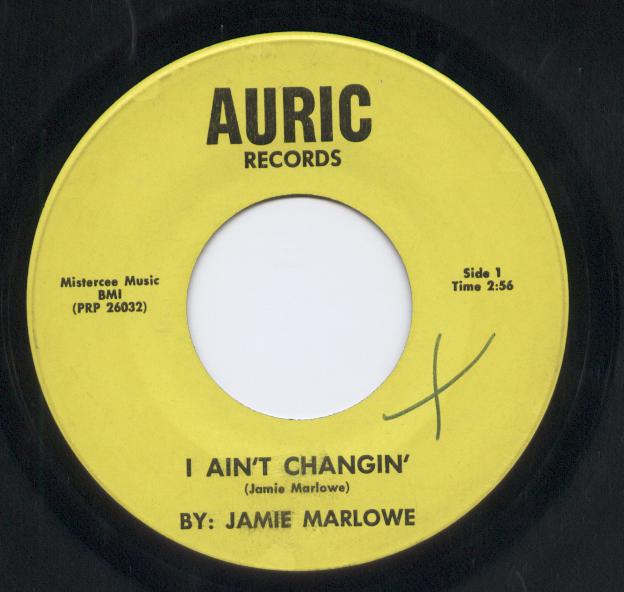
And here is "I Ain't Changin'" by Jamie Marlowe. Now, here we have the real "difficult listening" file. 

I don't recall where I got this record, and at some point it went into the "stack of records to listen to when I get a chance". First time I heard it has to have been close to 20 years ago, if not more, but I've never forgotten it. I immediately had both the song title and the name of the "artist" seared into my memory. 

I hope this was a vanity pressing, because if someone actually released this as a money-making venture on a "real record label", they were probably better off in another buisness. The annoying qualities of Mr. Marlowe's performance are matched by the wretchedness both of the lyrics and of the person those lyrics describe. 

To whoever drew the big "X" on the record label: it was richly deserved. Ick. On the other hand, as I said, I've never quite forgotten this record either, and now, perhaps, it can infect you, too. Tell me what you think!

Play:

Gettin' Tipsie

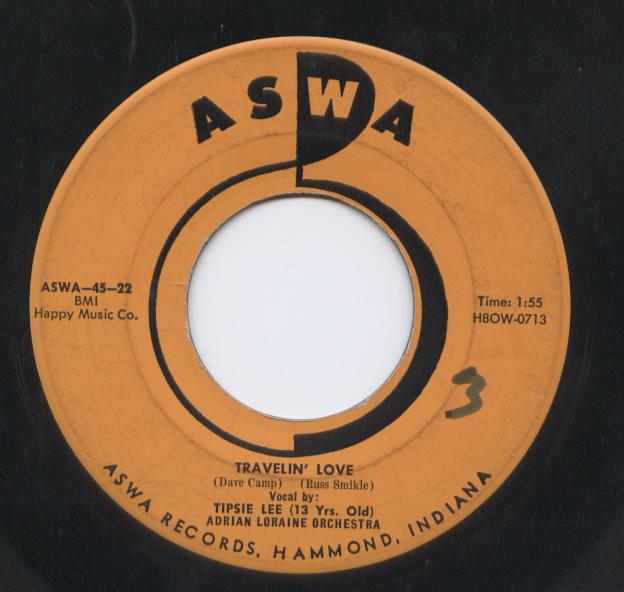
Next up, and not wholly unrelated to Ms. Layne, is Miss Tipsie Lee, who was apparently even younger at the time of this recording than Ms. Layne seems to have been trying to sound: according to the label, Tipsie was "13 years old" when this record was made, and I can certainly believe that. 

But as much as some others might quickly lump this into the "difficult listening" file, I find that there is something magical happening here. There are points in the song where it feels to me that the train (heard at the beginning and the end of the song) is about to slip right off the track. 

The energy in Tipsie's lead vocal is infectious, in a way that I rarely hear in the voice of a grown singer, and I'm a big fan of records where you can hear the intake of breath before a big vocal. 

I found this record at the late, lamented record store "Toad Hall", of Rockford, Illinois, easily the best record store I've ever been in. Three buildings, two of them combined storefronts. However, the owners had taken over the basement and what had once been upstairs apartments, and virtually every space in the buildings, even closets, where stuffed with records, except those places filled with books and magazines. The third building housed nothing but 45's and 78's. Sadly, the owners both died in the past three years, and the store is no more.

Play:

ADDENDUM, JANUARY, 2022: As mentioned in the comments, some wonderful person (or peo-ple) bought Toad Hall records and all of their inventory, and the store has been open again, for the last several years. If you're ever anywhere near Rockford, IL, I encourage you to spend a day there. 

They Don't Make 'Em Like This No More!

Here's a song which serves to remind me that musical releases haven't been much fun for a long time, and that record labels in the '50's and '60's could be expected, on a regular basis, to release something wonderfully insane, and to hold legitimate hopes that at least a few of those releases would be a hit. 

This (being a hit) wasn't the case for the song I'm describing here - in fact, it was a b-side to a hit, but it doesn't stop me from wishing that someone, anyone, would start releasing songs and recordings that are this goofy, again. 

The song in question is "Dum-Dum" by Joy Layne, from 1957. I found this on eBay last month, in an ad which also contained a sound clip of the record. 45 seconds or so of it, and I was hooked. The seller tried to make his sale based on the record being idiotic, but that thought never would have occurred to me.

Instead, I heard this record as a classic novelty record, set to a Latin-style beat then common and popular (and again, quite wonderful). Everything about this record works for me. The vocal is appropriately off the wall and just barely in control, the bass voice (which is clearly Thurl Ravenscroft) adds a nice touch, the arrangement is well done - hardly a throwaway for such a weird song, and fairly complicated - and the lyrics are genuinely weird: 

The verse begins: "Love me, you yes; Love you, no me; Love maybe you me, too..." The chorus ends: "Is, Am, or Ain't You Is My Darling?" I think we've all said, thought and/or been asked those things in our lives.

Play: