A look at some of the more remarkable items found during 40 years of collecting all manner of recordings. For information on saving these files, see the top box on the right.
What a cornucopia I have for you today! I have two singles - unrelated in style, background or any other aspect, except that both feature the same odd aspect of having the same word repeated over and over again, and both contain the same vocal sound, not often heard on records.
Before that, I will announce here that I have gone even further back in the archives and corrected three more posts from the initial year of this blog, 2005. That October, I featured a fairly horrible record by Pinky Pinkston (whom I was later to feature in much more detail at WFMU, as mentioned and linked in that post). I also offered, for the very time on this blog, two song poems, and, on what would have been John Lennon's 65th birthday, I shared four favorite excerpts from the often bootlegged "Get Back" sessions. While obviously those have become even more widely available in the more than 16 years since (and been the focus of a marvelous recent documentary), I still want to make this blog look like it originally did, so I have shared those tracks again.
And now, let's climb the Blue Hill
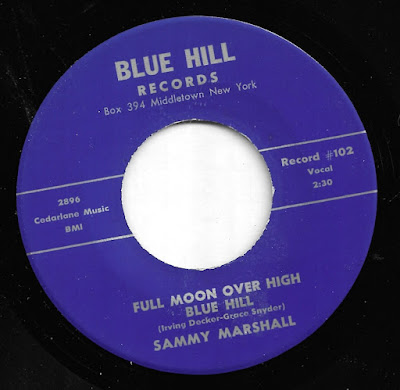
The Blue Hill label seems to have been the creation of a handful of people whose names show up on the eight known songs produced on the label. Seven of those eight tracks came out of the Globe song-poem factory, but here we have one which came from Lee Hudson's production house, with Hudson's go-to male vocalist, Jeff Reynolds.
This record apparently dates from 1962, and perhaps the lyricists expected a twist beat. I mean, it is called "Blue Hill Twist". But as you may know from experience with his productions, Lee Hudson didn't do twists. He did do slinky, bluesy numbers, though, and that's what we have here.
First, I will say that this record sounds great. But second, I will add that I've listened to it at least five times now, and I don't know what the hell he's singing about. And I really don't understand the buzzing bee sound he throws in. And yet, all in all, a very enjoyable record.
The flip side is from the folks at Globe, as indicated above. And for the third time on the record - including the label name and both songs, we have a reference to Blue Hill. This one is called "Full Moon Over High Blue Hill", and is sung by the inevitable Sammy Marshall. This one has some nice Hawaiian style guitar, but very little else to recommend it.
And now, something I am VERY excited to share. I have discovered yet another record by Merigail Moreland. If that name means nothing to you, click on her name at the bottom of this post, to find other posts I've made here about her, but also visit my lengthy posts about her at WFMU, here and here.
Anyway, I never would have found this record, had I not also been searching for records by her father, Don Moreland, as Merigail, in yet another reworking of her name, is here credited as Merri Gayle (another pair of releases had it as Merri Gail).
The record was released on the Beeline Records label, and (as was true of the record above) BOTH tracks contain the name of the label in their titles. Here's the better of the two sides:
I am increasingly in love with the track titled "Be My Beeline Baby", and it once again plays up how fantastic a singer Merigail was, even in her teen years - which, based on the little I know of her life, is when I'm guessing this comes from.
This was, in fact, the b-side of the single, but it is by far the stronger of the tracks, at least to me. But then again, the calypso shadings of the arrangement and fantastic horn track are right up my alley. All that pales, however, before Merigail's vocal, which I find to be off the charts sexy, particularly in the bridges, and even more so on the lines where she sings "I want kisses by the dozens", etc.
The flip side, "I'm Makin' a Beeline For You!", sung with Don Moreland, was the a-side, but it doesn't do nearly as much for me. The standard late 1950's big band sound is not a favorite style of mine, the song doesn't do it for me, either. Oh, and maybe it's just me, but knowing the singers were father and daughter make the whole exercise sort of weird.
But, as with Jeff Reynolds, on the previous 45, we have some bee buzzing sounds here, tying these records together in another weird way.
Okay, for the last few posts, by request, I have been sharing some of the best of my "Cut-Up's", reworkings of hit songs and other material that I like, in which replacement words are plugged into key moments of the songs. For more information, please look at my recent posts. Today I'm sharing one of my all time favorites.
But before I share this one, I have a question. Are people enjoying these, and wanting to hear more? This feels sort of self-indulgent to me, but won't feel quite so much that way if people are actually digging them.
Okay, so here's today's "Cut-Up". When Elvis returned from the army, he cut the masterful "Such a Night". It resides in my all time top 25 tracks that anyone has ever recorded, and remains my second favorite Elvis track, behind only "A Fool Such as I", but was shelved as a single in favor of the milquetoast "Stuck On You". Perhaps it seemed out of touch with the softer sounds of 1964. After the Beatles hit, it was belatedly released as a single and made the top 20.
So it was a natural for me to do a cut-up of this record. And the repeated lines, and story nature of the lyric, made it a natural for cut-ups, too. I think this came out great, particularly what I interspersed in with the grunting and chanting at the end.
There is a low level four letter word repeated here, and also another word which is not obscene, but is also not typically used in polite conversations, so this is probably not safe for work.
For my money, the best singer ever recorded, and that I've ever heard anywhere. No one comes close. His voice was the purest expression of joy, or sadness, or anger, or righteous indignation, or whatever else was called for. In addition, his singing was a natural extension of his speaking voice, unadorned by any embellishment, misguided training or showboating, and that's exactly the sort of singing we don't have enough of today. His voice is pure emotion, expressed directly. His voice is the sound of America. His voice is the sound of life being lived well.
And not only that, Pete was without question in my mind, the most important American musician of the 20th century. I'm not saying that based solely on his songwriting or performances - I wouldn't try to support that statement. What I mean is: looking at any prominent musician of the century, and the totality of what each of them did, in all areas, musical or otherwise, again, no one comes close. He was one of the most important Americans of the century, period.
My main intent here is to share some of my favorite Pete Seeger tracks, and I'm going to start that right here, with a sidebar a few songs down. For the most part, I'm not going to focus on the most famous songs Pete is associated with - those can be found in myriad places - but instead will feature the lesser-known songs that he recorded that resonate the most with me, with a few exceptions in chronological order. I suspect I own close to, if not more than 95% of the recordings that Pete released, either in their original formats or re-releases. These are my favorites.
Before starting that chronological ride, I want to start with the recording I consider not only Pete Seeger's finest moment, but one of the two or three greatest single tracks ever recorded. This is one of those perfect records that I could listen to multiple times a day without getting tired of it. It's found on an album recorded at the Weavers' reunion concerts at Carnegie Hall in 1963, but aside from some key instrumental backing from other members of the group (the double bass in particular is essential here), this is all Pete's show, or rather, Pete Seeger with an choir-by-audience numbering in the thousands.
Listen to how simply Pete suggests they sing with him, going into the second chorus, and how, by the end of the song, it's a towering massed vocal singing with him. It helps that Tom Paxton's "Ramblin' Boy" is an incomparable song, but the magic here is what Pete does with it, with his singularly wonderful voice and with the audience.
Now it's time to step back a further 17 years or so from 1963. Next up is a song recorded for a tiny label in the mid-1940's, at around age 25, along with several of his lefty compatriots. "Listen, Mr. Bilbo" is, most directly, an indictment of a truly awful human being, Theodore Bilbo, who was concurrently a member of the U.S. Senate and of the Ku Klux Klan. But if you overlook the specific reference in the title, and adjust the lyrics to include what some today's consider to be "scary foreigners", this song could just as well be used as an indictment of xenophobia in general, and of any number of today's politicians. The energy and emotion on this record are just unbeatable.
The history of the Weavers, which Pete formed with three like-minded musicians, is well known to many, and easy to find for those who aren't aware of them. Suffice it to say that they became hugely popular in 1950, but by 1953 had broken up after becoming pariahs thanks to the witch-hunts of the McCarthy era. At the end of 1955, they regrouped and appeared in concert at Carnegie Hall. From that concert come the three incomparable performances below.
First, this musical trip "Around the World". I love the energy of this performance, the good spirits, and of course, the Weavers' magic vocals:
Then, one of the most gorgeous melodies I've ever heard, that of an Indonesian lullaby, "Suliram", made even more lovely by the Weavers trademark and unique harmonic blend. When Pete takes the lead vocal part way through, his voice is tender, sweet and intoxicatingly beautiful. If you have a chance, look up the translation to these words into English - they make me tear up every time.
And perhaps the most popular melody that Pete ever brought to the US, that of "Wimoweh", heard here in a fairly accurate (vocally, anyway) recreation of the original 1939 South African 78. The vocal blend in the section from 1:04 to 1:19 is just stop-me-in-my-tracks gorgeous.
The Weavers returned to recording after that concert, with Pete remaining a part of the group for about two years, until he quit in disgust after the other three voted to sign on to sing a cigarette commercial (which ended up never being used, anyway). During that time, they made some wonderful studio and concert recordings. This is a favorite, a duet between Pete and Ronnie Gilbert on "The Wild Goose Grasses", with more of those amazing harmonies on the choruses:
While making periodic recordings and concert appearances with the Weavers, Pete recorded extensively on his own, both in the studio and in live performance. Folkways Records released dozens of Seeger albums during the '50's and early '60's, sometimes more than a half-dozen a year. From one of those albums, here's one of my favorite of Pete's overtly political records, a union shouter, recorded with a chorus of friends, including a young Mary Travers, "We Shall Not Be Moved":
Many of the remaining live tracks, below, display the thing about about seeing Pete Seeger in concert that many fans loved the most - his ability to get a crowd of people singing together, often in three part harmony, and his near insistence that those in attendance give it a try. At best, this resulted in soul-affirming moments of beauty, and even breathtakingly gorgeous choral sounds. The track I posted at the top, "Ramblin' Boy" is a wonderful example of Pete's voice with a audience full of singers, but there are many other great recordings of this type, as well.
The following track, "Deep Blue Sea", is the first track on the first Pete Seeger solo album I bought. The recording quality is relatively poor, but the performance shines through, including a great and unusual exhortation from the singer, a dejected "I hardly hear ya", which works wonders at getting the reluctant to start singing:
At some point in the 1950's, Folkways Records released a multi-artist boxed set of "Songs of the Civil War". From that set come two songs which each contain one of my favorite Seeger vocals. First, this rousing version of "John Brown's Body":
And this gorgeous, achingly touching rendition of "Tenting Tonight":
A sidebar here.
It is worth noting - no, it is required to note here - that, while almost all of what I've shared so far was being recorded - indeed, while Pete made at least five albums with the Weavers, and perhaps three dozen albums for Folkways, including hundreds of tracks, he was, the entire time, facing the wrath of the U.S. Government, including what seemed likely to be a likely prison term, essentially for refusing to reveal his private thoughts.
Indeed, the most significant moment of his life I can revisit is what happened when he appeared before the House Un-American Activities Committee, to answer charges that he was a communist, among other things.
Many others had cowardly turned over names of friends and former friends to the committee, while even more had reasonably taken the fifth, which had imperiled if not ended their careers. Pete took a riskier, and flat out ballsier step, one I don't believe anyone else took - he essentially pleaded the First Amendment, telling the panel that, as an American, he had the right to believe whatever he wanted to, and in addition, was entitled to be free from the need to be compelled to reveal those thoughts in such a situation as he was then in. Basically, he told the committee that, under the constitution, his beliefs were none of their business. In 1950's America, those were daring things to say. Read his entire testimony here - it is bracing.
And for this, facing the charges brought, he could have faced a decade in prison - he was actually found guilty and sentenced, although the ten counts of one year each were to be served concurrently - and was under the threat of this sentence for nearly half a decade. It's a good thing he didn't have to serve this term in prison, but a shame that the case was thrown out on a technicality, as it might have been (had it been decided correctly) a nice precedent to prevent or halt similar Congressional abuses in the future.
But all of that was going on while Pete toured the country, spreading the word that through music can come peace and brotherhood, and, not coincidentally, being the key figure in the flowering of the folk revival of that era in the process.
And now, back to the countdown.
In the early 1960's, Pete Seeger was signed to Columbia Records, and he remained there for a decade. Buried in the middle of an otherwise typically vocal album from early in that tenure, was one of the loveliest pieces of guitar music I've ever heard. I spent years trying to learn to play even a fumbling version of this twelve-string masterpiece, "Living in the Country":
Pete's most famous non-Weavers album is undoubtedly the one recorded at Carnegie Hall in 1963. The entire album could be highlighted here, but this is one of my favorite moments, a song sung with a group of young "Freedom Singers", and capturing various political issues of the moment, "If You Miss Me At the Back of the Bus":
Around the same time as that recording, a performance at the Newport Folk Festival was captured, and this song from the concert was released. To me, it is among the prime examples of Pete's ability to lead a crowd in group harmony - as he first encourages them to sing, then goes over each part, then, realizing it should be in a higher key, moves his capo before launching into an inspired rendition of "Oh, Mary, Don't You Weep". The spoken opening is a great demonstration of how Pete's singing voice was just an extension of his way of speaking, and the moments here in which he sings a single high note over the harmonizing audience... well, that's something he often did, and it was always an amazing sound, rarely better than it is here.
As the battles of the '60's were fading into history, and the Vietnam War was winding down, Pete released his final album for Columbia. This track was little noticed at the time (indeed, as was the entire album), and it's very telling to realize how much stronger the reaction might have been if Pete had released his bouncy little tribute to the wisdom of Ho Chi Minh in 1968, rather than in 1973. As it is, "Uncle Ho" still contains a lesson which the US (as well as other governments) still refuses to learn, "If a Man Will Stand for His Own Land, He's Got the Strength of Ten".
In 1980, Pete released a full concert on a three record set, a concert and album package meant to demonstrate the art of leading the singalong. This is Pete's greatest album by a wide margin, and it reaches its zenith on the following song, where Pete turns an auditorium full of strangers into a full throated choir, singing in many-part harmony, until Pete is simply accompanying them on his guitar. The last few moments of "Run Come See the Sun" are perhaps the most sublime in Pete's entire catalog, despite barely even featuring his wonderful voice. If the sound of this track doesn't move you, then I'm not sure you and I have the same definition of "music".
Around 1984, Pete joined forces with Ronnie Gilbert, Arlo Guthrie and Holly Near, formed their first initials into the group name HARP, and played a few shows under that name. From the ensuing album comes another sweet singalong. The key moment here comes near the end - and I won't spoil the surprise - after Pete observes that once you've really learned the song, the song's almost over, he makes a more touching comment. Here's "Somos El Barco":
To my mind, no collection of Pete Seeger tracks would be complete without one of his performances of "Abiyoyo". Taking a traditional African song as its start, Pete built around this tune a story of how a boy who only wanted to sing was banished from his land, until that far off land was threatened by an ogre, at which point the boy and his father triumphed over the ogre with music and a little magic. Replace the boy with Pete himself, and the ogre with the witch-hunting McCarthyites and HUAC, and what you have in essence is Pete's own story. This is the version of the story that my kids always preferred, from a performance in the early 1990's, when Pete had perfected the story and told it with just the right amounts of scariness, tenseness and, later, joy:
And finally, moving back to 1974, here's my second favorite Seeger track, a performance with his great friend Fred Hellerman on the folk standard "Banks of Marble". The track here, with banjo, guitar and piano, goes into a rolling rhythm, as their voices harmonize as in the old days, and they sing a song which is, sadly, yet to lose its meaning - it is as relevant today as when it was written, about 65 years ago. To quote a well known Seeger song: "when will we ever learn?".
Well, not quite finally. I'd like to pay my own vocal tribute to Pete. Of all the songs I learned from Pete, this is the one I have sung the most often. It's not one of his own songs - it's called "Way Out There", and it was written by Bob Nolan of the Sons of the Pioneers, and I learned it from an album Pete did with Arlo Guthrie. This spur of the moment performance is from 1990, and features my great pal Stu and me. After some initial silly comments heard at the start, we get right into the song, and aside from a few lyrical flubs, I think it's a rather nice performance.
And here's my prized possession - a photographic memento of one of the two times I got to have a conversation with Pete, in this case in the late 1990's, following a folk festival fundraiser which had gone on about four hours (hence the glazed look in my eyes...).
Thanks, Pete, for the myriad ways that you colored our lives, made it a more beautiful, musical world, help open our eyes to so many things, and worked to make America and the world a better place. And in a more personal note, I simply can't imagine how my life would have been different, although I know it would have been for the much worse, had I not come to find you, your music, and your life story. Thanks.
Like many people my age, my first exposure to the wonders of Louis Prima was hearing his performance as King Louie in Disney's "The Jungle Book". I was seven years old, and smitten with the whole film (it remains my favorite Disney film), but no part more than the King Louie scene. The soundtrack to the film was undoubtably the first album I ever owned.
Later trips through my parents records introduced me to his amazing rendition of "That Old Black Magic", with then-wife Keely Smith (she recently took part in a truly abysmal performance of the same song with Kid Rock, a man who clearly has not found something - anything - that he's good at, yet) (well, apart from proving true, yet again, an old saying often attributed to P.T. Barnum...).
That led to his "Just a Gigolo/I Ain't Got Nobody" medley, which is so great that not even David Lee Roth could screw up.
Anyway, a series of recent events has had the side effect of giving me a reason to go through a bunch of my 45's, and one of the first I came across was a favorite Louis Prima performance. While I'm sure it's far from unknown, it's also not exactly well known. But it has a sound and an energy that I just love.
It's a version of a Louis Armstrong tune, "Ol' Man Mose". I really enjoy the interplay with the backing group (Sam Butera and the Witnesses, as always). The typical Prima record had a lot more combo jazz on it - it's almost completely absent here, with the instrumentation being limited to bass and drums for almost the entire song, but it really works, and focuses the song on some fairly amazing lyrics. As I said, the song is attributed to Louis Armstrong, but the version I found from Armstrong doesn't even have half of these lyrics, so someone added quite a few new twists and turns to the story. Have a listen:
By the way, the other side of the record was a fairly lifeless reading of the number one hit, "Wonderland By Night" (actually, "Wonderland" was the record's A-Side), putting this record's release around 1961 or so.
I'm slowly plowing through a large mountain of reel to reel tapes, which I've bought here and there and everywhere, over the years. The pile actually tends to get bigger before I can make it smaller, if you know what I mean.
I was quite taken with this performance, which was the only thing notable on a three inch reel that I recently listened to. Everything I know about can be seen in the copy of the tape package, above. I would assume this was a vanity recording, or at least at the edge of such a definition - perhaps a band who was making a professional quality tape in the hopes of securing some sort of contract.
I'm not sure I'd call this good, but I do find it fairly compelling and very interesting:
There really is no competition, as far as I'm concerned, for the best or most beautiful Christmas song. Far and away, that vote goes to "Silent Night". By the same token, there's no race for second place, either. That one is "O Holy Night", which is well above all the others, apart from the one at # 1.
Here are two unusual versions of "O Holy Night", both of which I love. First up, The Christmas Jug Band. I've enjoyed several tracks by this group, more often than not, because of the involvement of Dan Hicks, surely one of the greatest singers I've heard. But here, in my favorite of their tracks, it's not Hicks' singing on display. And anyway, in any version of this song, the song itself needs to be the focus, as it surely is here.
And what a singularly marvelous piece of work this is. Start with this great song, and apply a wonderfully loose, folky arrangement, with altered (but still wholly appropriate) lyrics here and there, sung by a cadre of folks who sound like they might be trying out this arrangement for the first time. It’s just that free and joyful. And then there’s a perfect recorder solo, and when the vocals come back, there are two magical moments on the word “divine”, where the three main singers hit a major triad as if the whole song had been waiting for them to get there. This is on my very short list of the best Christmas records ever made, and one I’ll never get tired of.
In a completely different direction, I offer up Ellis Chadbourne, a singer I was introduced to by my friend Citizen Kafka, a man I have subsequently lost touch with. Also offering up rewritten text, in this case significantly so, to remove all Christian references, Mr. Chadbourne instead is seeking for a Holy Night in which the Bomb has been banned, and peace reigns over the Earth.
This (and all of Mr. Chadbourne's work) tends to be quite divisive - either you "get it" or you don't. It was a early moment of bonding between me and Citizen Kafka when I focused in on Chadbourne's material as the real heart, the key material within what he had shared with me.
Yes, some say he can't sing, and/or even that this is painful to listen to. I won't disagree with anyone about taste, and I recognize that there is one howler of a note here.
But I will disagree (and have, quite forcefully) with those who have said there is nothing to "get" - there is a passion, a life-affirming spirit captured in Ellis Chadbourne's records, particularly this one, which gives me chills. When he gets to "O Night Divine", and seems at the very top of his range, it takes my breath away - and yet then, I realize there is a higher note yet to come - will he make it? When he reaches that note, just at the end, I feel I am hearing a man singing directly to God, and I rarely can hear this track without tearing up.
(Addendum, 11/30/21: See the comments, below. Citizen Kafka reached out to me, via the comments, to try and reconnect, and to tell me of an then-upcoming Ellis Chadbourne CD compilation. Sadly, Citizen Kafka died just a few weeks after making that post, and as far as I can tell, that CD compilation was never produced.)
This song was actually featured as part of a post to the 365 Days Project last year, but I fear it got lost as part of a collection of random singles that I posted to that project, all in the same day, and it really deserves to shine on its own.
Here's a portion of what I wrote at that time about the song, "Jingle Down a Hill" by Gaitley and Fitzgerald:
This one is so good I can still picture where I was the first time I heard it: Almost 20 years ago, I was on my way to a new job, and listening to a cassette tape I had made of a stack of 45's, recorded earlier that day (with one of those record players which would drop the records one at a time). "What the hell was THAT" went through my mind, and I rewound it and listened about five more times. It's actually the B-side of a song which has been included on several psychadelic comps, but that song on the A-side doesn't move me at all.
On the other hand, this B-side... well, it's just one of the loveliest things I've ever heard. The folky arrangement fits the song perfectly, the Everly Brothers harmonies on the bridge get me every time, and the simple piano figure at the end of each chorus has echoed in my head since that first listen in 1990. The cruddy production prevents me from making out every word, but I can get most of them, and they portray a sweet description of tender love for the singer's girl, and time spent together.
"Whistlin' as we walk along, smilin' all the way
Singin' with the summer wind, slow and happy days
Alone and free, the world to see, Jingle down a hill"
Although I'm sure I have a couple of the words wrong, here and elsewhere in the song, I certainly get a detailed picture of the life the singers are describing, and the imagery is absolutely magical. If anyone wants to have a go at all of the lyrics, and perhaps catch a few I've been unable to make out, by all means do. I've listened to this record hundreds of times over the years, and it never gets old, and always hits me in just the right place.
As a followup to my recent post at WFMU's Blog about "The Three Little Pigs", I thought I'd post more of the obscure (and, to varying degrees, wonderful) 78's and 45's that my mother recorded on a reel to reel tape back in 1964, for posterity.
First up, two absolutely wonderful songs from Al Goodman and his Orchestra. These are not children's records, but they were presented to me in that way in childhood, as both were featured on that tape I just described, a tape which was almost exclusively featured kid's records.
In in both cases here, though, these are hi-fi era remakes (although these records are admittedly no longer "hi-fi") of orchestral favorites from the dawn of recording, songs originally recorded for Victor in the first decade of the 20th Century.
From the opposite end of the 'Wonderful' spectrum, come two sides of a children's 45, which apparently were excerpted from an album titled "Songs About Words", credited to The Sandpipers, Jim Timmons and Orchestra. These are genuinely weird, especially the first one, which is titled "Rattlesnake":
Next up are two songs that were favorites of mine in 1964 (when I was three, then four). The first appeared on the Cricket label - it's a song that I actually used to sing at that age - I have a tape on which I'm singing it, none of which is odd, except that the song is "The Little Dutch Girl". Here's the record:
And here is a series of little poems and songs, some of them quite odd, and another favorite from my childhood, one with no artist credited, titled "More Pussy Cat Rhymes":
Here's a wonderful little record from the early 1950's, if not earlier. I found out recently that it's a vintage "corny" group (a category that included Spike Jones, as well as the Hoosier Hot Shots). In this case, it's The Korn Kobblers, although this performance was credited to someone else once it was reissued on a children's label, which is how I heard it. It's the old song "Polly Wolly Doodle", but I've always been quite taken with just how much is going on during this performance, especially near the end:
Finally, an actually hit group, The Ames Brothers, with a song from the mid 1950's, featuring an extremely clever lyric and great harmony singing, "I Saw Esau". Again, this is not a children's song, but as with the first two songs (above), it was presented to me as such, since it was on our tape of children's records:
I'll say right off the bat that today's selection is one which may have many listeners having the sort of negative response which may range anywhere from "no, that's not for me" to violently stopping the sound file with something approaching disgust. And I'll admit that the opening 19 seconds, which contain a dramatic recitative type introduction, are cringeworthy, and I encourage you to wait them out and try the rest of the song.
There is simply something about a certain subset of teen girl records from the late '50's and early '60's that makes those records connect with me in a way few other records do. I've already shared the Merigail Moreland recording of "Oo-Lee, Papa", in this blog and elsewhere, and the masterful "What's She Got (That I Ain't Got)".
In this case, the song is "She's Going Steady with You", by Janie Grant, the B-side of a hit song from 1962 called "Triangle". While the A-side visits much the same topic within the same genre of music, the real winner is hiding on the flipside, and should have been the hit.
It helps that the song is, at times, taken almost directly from the song "A Fool Such as I", in terms of chords and melody, and that the overall feel is similar to Elvis' rendition of "Fool" (perhaps my favorite of Elvis' big hits). But there's something more to it, and for me, that's in the singer's performance.
There are at least as many teen girl songs in this genre that I can't stand, the worst of all perhaps being "Bobby's Girl", and that's where I have a hard time explaining what's wonderful and what's horrid. For me the difference tends to be in what I perceive in the performance.
In "Bobby's Girl" and its ilk, I don't sense for a moment that the singer or anyone else on the record believes the lyric - the singer sounds like she's there to do a job. On today's record and others I have shared and might share, I sense that the singer feels the lyric with every inch of her being, perhaps has even lived it, and I also find that the music sounds as if the musicians were trying to make a good record, rather than simply make something that 13 year olds might like for a month.
ADDENDUM, 2021: After writing this post, I heard from Janie Grant herself, who confirmed that, yes, this was a song based on personal experience, as I had perceived upon hearing it.
I have no real clue how many folks are reading the these posts, but I wanted to involve as many people as possible by asking you to guess the recording act heard on this record. Comments are always welcome, and can be shared by clicking on the comment button at the bottom of any post.
Anyway... The Golden Age of Novelty Records (roughly 1956 through the late 1960's) is, in my opinion, well named. There is a virtually endless list of funny, odd, and downright peculiar records from that era, hits, near hits and obscurities, that were made in order to deliberately make people laugh, become confused and/or collapse into bewilderment.
Certainly a favorite of mine from that era is Rolf Harris' "Tie Me Kangaroo Down, Sport". It was a massive hit, one of the bigger hits of any genre in 1963, and like most novelty records, would seem to be the type of thing that wouldn't really work well as a cover record or remake.
Novelty songs as different in style and quality as "They're Coming to Take Me Away, Ha Ha", "Witch Doctor", "Hello Muddah, Hello Faddah" "My Boomerang Won't Come Back" and "Tie Me Kangaroo Down" are all so unique, and uniquely tied in with their creators that to have made another version, particularly while the song was still a hit, seems ludicrous.
But here we have just such a cover version. I would never have expected this song to be covered, and I never would have expected this recording act to have done such a record. The charm of the original is completely lost in this overblown version, with it's sound effects, unnecessary additional shout outs, such as "in memoriam", and the sheer incompetence shown by the singing of the line "watch me wallaby's feed" as "watch me wallaby's feet".
Anyway, let's play guess who made the record. Here 'tis:
Today I'm sharing three of my newest 45 rpm acquisitions. All three come from labels associated with the song-poem field, but I suspect that only one, and perhaps two, of the three. are technically song-poem records.
That one I'm sure is a song-poem, is "Atom Dynomic Dance" by that man about town, Phil Celia. One doesn't come across a twist styled record suggesting a dance based on an atom bomb explosion every day. Not only the words strike me as some amateur's attempt to clever, but the fact that the melody (at least as sung by Mr. Celia) doesn't quite fit the chord changes, tells me that this wasn't designed to be promoted as an actual hit. The Tin Pan Alley label on the record helps, too. And is "Dynomic" even a word? Okay, everybody! "Let's Go Boom and Mushroom, Let's Be an Atom Blast...!"
Next up is Barney Spencer and the Vellaires, on the Vellez label. I have only a few records on this label, and each of them is odd in its own unique way. This is just a cute little song, pushed over that line between fun and really fun by the singer's Scandinavian accent. I have a suspicion that this one - "Beginner's Luck" - was a vanity release, but I could be wrong.
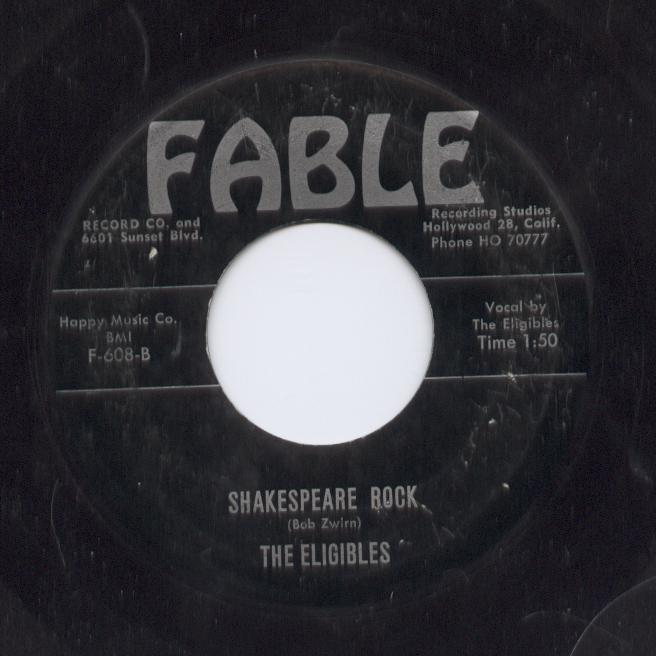
And then there is "Shakespeare Rock", by the Eligibles. Records on the sometimes song-poem related label Fable never cease to amaze me, whether they are song-poems or not. The lyrics of this one strike me as far too knowingly ironic, and it also seems too well arranged, musically, to be a throwaway song-poem. Plus, the flip side was a cover of a minor hit song. I suspect this record was meant as a deliberate joke, and whether I'm right or not, it sure as hell makes me laugh. It's well done, all the way around. I'll let you discover its charms yourselves.
Just in time for summer, I'm sharing a little known, ridiculous novelty song from the early 1960's (one which came out on a major label, no less - Warner Brothers!), called "Beer Beer Bottla Beer" by A.C. Ducey.
I first heard this song on the Dr. Demento show around 1980, it immediately went into heavy rotation on my home playlist; I spent the next 20 years looking for a copy, finally securing one on eBay a few years ago.
I don't actually drink beer, finding it quite vile, thank you, but that doesn't stop this record from being one of my all time favorite records. That's not Thurl Ravenscroft singing, but for more than a moment one might think it is, even though I now suspect that the vocal has been slowed down for effect. And as one might have gathered, I'm a sucker for an eccentric bass vocal performance.
There is so much to love here, from the double tracked vocals, which start and stop more or less at random, to the understated arrangement, to the minimilist lyrics ("whattaya mean, wait'll next year" being my favorite moment), to the clinking of beer bottles as the instrumental sections begin.
I can't imagine a way this record could be improved!
I hope this will become one of your favorite songs, too, whether you enjoy beer or not.
ADDENDUM, 1/22/23: My best pal Stu has demonstrated, by speeding up this record a few keys, that you can then tell quite well that you're hearing the singer's natural voice in that higher key. This confirms that the recording was slowed down for effect and that it's also clearly not Thurl Ravenscroft.
I don't really have any clue how many or how few of you are out there reading this little site, but if you've been here from the start, or read the archives, you may have come across my post about "The Moreland Tapes", connected to the posting of the song "Head Cheese". You can read it here:
http://bobpurse.blogspot.com/2005/07/cheesy.html
Well, since the last time I posted, I've learned a lot about the singer of that song (and of the other song referenced in that post, "Reputation"). Another piece of writing I did about these tapes came to the attention of a relative of the Moreland family, and I eventually heard from two of Merigail (correct spelling) Moreland's relatives.
This quite quickly became the most bittersweet of meetings: I was, on the one hand, able to learn that Merigail, whose voice I'd adored on these tapes for so many years, actually made a handful of records, copies of which I was sent. I even learned that she was(perhaps briefly) a Chicago area celebrity, co-hosting her own "American Bandstand" style show, locally, while still in High School in the late 1950's. On the other hand, I was deeply saddened to learn that her life was cut short by Lupus, at around age 48, in 1991.
She apparently worked as a singer for much of that short life, and I may yet get to here more of her recordings. But for the time being, I have spent the last six or seven months, listening, obsessively at times, to a single she released on a small Chicago label, in 1960. There were actually at least three singles, under then name "Merri Gail", one in 1955, and two in 1960, but this one is the "shoulda been" hit, and the quality of her singing just gives me chills at times. And she was all of 16 or 17 at the time.
Today, I'm sharing both sides of this 45. The version of "Unchained Melody" is first rate, with a great arrangement (love that accordian), and a sexy, longing vocal that seems more knowing than I'd expect from someone so young. Also, the growth in ability and technique from "Reputation", just three years earlier, is astonishing. Here's Merri Gail's "Unchained Melody":
But as great as I think "Unchained" is, it was only the B-Side to the completely wonderful (if oddly named) "Oo-Lee, Oo-Lee, Papa, Oo-Lee". There is not a thing about this record that I don't adore right down to my bones, and it's flown right to the top of my favorite records of 1960, along with "Cathy's Clown", "It's Now or Never" and the Olympics' "Dance By the Light of the Moon".
For "Oo-Lee", before even considering the lead vocal, there is the goofy way the song starts in the middle of a musical phrase, that great bass voice, more coloring from accordian, and a swinging late '50's take on doo-wop. The lyrics are a bit ridiculous in places, but Merigial just sings the hell out of it, suggesting a depth of emotion behind the words that makes me believe she meant every word of it. And the dichotomy between the softly longing vocal of the choruses and the demanding, pleading vocal in the bridges is great, too.
It pales next to the tragedy of her short life, of course, but I was truly hoping to someday find Merigail Moreland, meet her, and tell her how much I've loved her recordings, and I've been very saddened to learn that this can never happen. Is it possible to have a crush on a singer who was grown before I was born, and who has been gone for 15 years, based on nothing more than her recordings?
While the rest of the musical world is paying tribute to John Lennon, on what would have been his 65th birthday, by remembering his music and his causes, and amongst all of the radio tributes, I thought I'd post a few tracks that are, perhaps, not getting the airplay that "Imagine", "Come Together", "Twist and Shout" and "Born in a Prison" have gotten today (well, maybe the same amount of airplay that "Born in a Prison" got, since I have my doubts that that one was heard by too many listeners).
I'm a devotee of the "Get Back" tapes, the endless hours of recordings which captured virtually every moment that the Beatles were in the studio (or, for the first two weeks, the film set) in January of 1969. I know that for some people, these recordings are the perfect thing to encourage them to leave the room, but I have listened to them eagerly for years. Today, I have three odd recordings from those sessions, and one rockin' version of a song that ended up on the "Let it Be" album in a vastly different style.
The song from "Let it Be" is "Two of Us", heard here in a slightly incomplete form, as an uptempo rocker, a much, much better setting, in my opinion, than the rather dreary version which was released. The joy between Paul and John, in sharing this arrangement, is palpable.
Moving on to the true "outtakes"... The most well known is the improvised (and Lennon-led) song "Suzy's Parker", a condensed version of which showed up in the film "Let it Be". This is the whole thing, though, in all it's ragged, loose glory. (The file has it as "Suzy's Parlour", but that's incorrect...)
Third up is a goofy series of performances that three apparently drunk Beatles performed, after returning from lunch on January 10th, and after George had announced he was quitting the band effective immediately. John riffs on "Don't Be Cruel", and then the three of them wander around with some Bossa Nova songs for a few minutes, with Paul offering some ridiculous vocalizing, and a few lines from Elvis songs, as well. I find this little segment endlessly entertaining.
Finally is a song I might very well put in my top ten favorite Beatles songs, even though it was never released, and was, in fact, an improvisation. It's January 9th. George complains about the way the band is set up, and plays a few chords to demonstrate. Paul joins in on bass, continuing, even though George stops almost immediately, and leads the rest of the band into what becomes a rockin', if somewhat disjointed, song, a song poking very sarcastic fun at a politician, Enoch Powell, who was making news that week by making some extremely distasteful comments about Pakistani immigrants. The song is called "Commonwealth", and I'm posting it for John's birthday, even though it's Paul's improvisation, first because it's such a great little number, but also because John's addition to the song (the "Yes" shouts in the chorus, and a few other comments), help make the song much better, especially in that Paul cracks up a few times in response to John. (It is not, as some casual listeners have thought from time to time, proof that Paul holds racist views - he's clearly satirizing a racist.) I once wrote out the words to this song (as I heard them), including the points at which Paul mumbles gibberish, unable to think of a rhyme, and will happily send them out or post them, if anyone is interested.
When I first joined my own rock and roll band, at age 20 or so, in which we first did nothing but Beatles' songs, then later wrote our own songs but interspersed Beatles material into our act, we named ourselves "The Commonwealth", after that song.
Hope that some of these, if not all of them, are new to you, and that you enjoy them. Happy birthday John, wherever you are.
This is a continuation of my post honoring Michael's request to hear songs from my June listening list, which I posted a few weeks ago. In addition to the Percy Faith songs, detailed above, I'm also sharing two songs from 1960 and one from 1959.
"Pineapple Princess" is goofy and cheesy, but it pulls me in with the stereotypical hawaiian arrangement, and a better than usual vocal from Annette. This is really the only record of hers that I love.
"Bumble Bee" is the other end of the spectrum, a weird, almost spooky arrangement, far more poppy than I'd expect from Lavern Baker. I first heard this, many years ago, on a poorly recorded reel to reel tape of a poorly received AM radio broadcast. That could be the kiss of death, but what I heard through the muck intrigued me, and once I got a better copy, I was not disappointed.
"My Heart is an Open Book" is a left-field hit from a guy - Carl Dobkins, Jr. - who only had a couple of hits. That this was a top three smash is yet another reason that I wish today's music and charts were more varied and unpredictable (and contained more interesting music....)
So far, I've offered up records that, however odd they may be, I also find marvelous through and through - musically, emotionally, intangibly, etc.
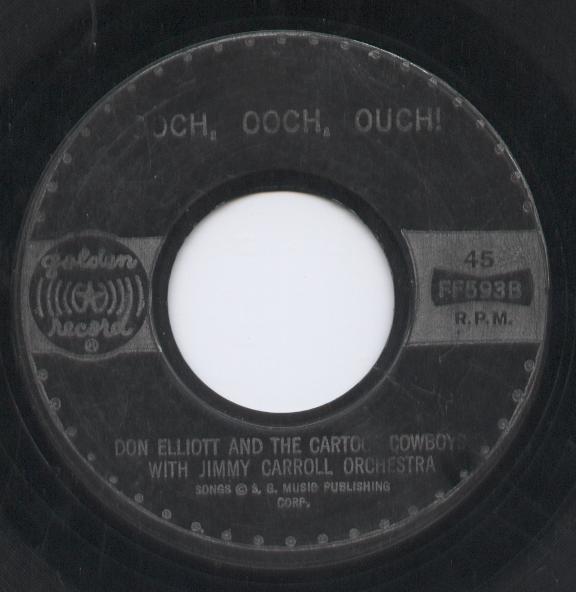
But now, I've chosen to write (and not for the last time, I'm sure) about a record I love primarily because of its complete and total weirdness. As you can no doubt tell from the above, this is a kids record, one which I can recall being in my possession (or perhaps it was my brother's, first), as far back as I can remember. (As always, it's available at the gmail site, linked to the left, with the instructions at the top of this screen.)
Several records from my childhood collection will no doubt make their way to this forum, and there were plenty of them that I thought were weird (and a few I considered scary), even in early childhood. But this was weirder than most of the others. For one thing, it's FIFTY FOUR SECONDS LONG!!! It's the whole side of the single, and it times out at well under a minute! I can literally see the spaces between the groove as it moves towards the center of the record.
Just as odd is the performance of the song. First, there is the fact that (to me, at least), it sounds like we join the song in progress, almost in mid-breath of the singer, and certainly after some sort of music has already been played.
Then there is the deeply weird lead vocal, the overly peppy chorus, singing in such jolly spirits about being conked on the head (I particularly like the happy way they sing "He's a grouch", which is repeated three times), and the wacky sound effects. Not unheard of in kids records, but the feel of this one is sort of different, and the sudden ending just makes it weirder.
In addition, although the singer is presumably a cartoon character, singing about an occurance which is not uncommon for cartoon characters, I have no clue who he's supposed to be. Most of the kids records I've ever seen, if they are in character, have the name of that cartoon personality on the label, whether it's "Captain Kangaroo and Mr. Green Jeans sing..." or "Popeye Sings....". But this one is by "Don Elliot and the Cartoon Cowboys".
This last point sent me, quite recently, for some answers. There is a famous Don Elliot, who is apparently primarily known as a jazz trumpet player, but who is also listed as a vocal talent in some searches, and was one of the hipsters behind the Chipmunks-meet-Bebop project "The Nutty Squirrels", in late 1959. So I'll assume this is the same guy.
But I still don't know what the hell led to this record, or who it was that listened to it and said something along the lines of, "yup, that's perfect - that'll be GREAT for our next kids' 45"...
I'm the father of two amazing young adults, married to the most wonderful woman in the world, and I work in the mental health field. I play several instruments and record my own music. I'm a long time record collector, hoarder of unusual, rare or unique recorded sound, musical, spoken word or other, and am glad to have found this outlet to share some of my favorite parts of it with others.