A look at some of the more remarkable items found during 40 years of collecting all manner of recordings. For information on saving these files, see the top box on the right.
Today, it's back to our road trip, at least...sort of. But it's really a trip inside the fascinating mind of Norridge Mayhams. For today's record is one which appeared on the "Mayhams" Little Shirley Records label (got that?), but which has key differences from the one record on the same label listed at the song-poem database site. On that site, the one record identified, from 1962, has a different label number, the same song on one side, but a different song on the other side. That song is listed as "Zoomba High Kicka Zoomba", which is a familiar Mayhams title, appearing on at least three different Mayhams releases that I know of.
The funny thing is, the song listed on this record, identified with the unwieldy titles of "The Pennsylvania TWIST and the California TWIRL", IS, in fact, "Zoomba High Kicka Zoomba", perhaps the very performance heard on that other "Little Shirley" release. The only difference seems to be that a prelude has been attached to it, telling us to do the dance steps referenced in the new title. Oh, and the singer, Miss J. M. Abreau, offers up a few shouts of encouragement to dance during the song, as well.
Unless I miss my guess - and it's quite possible, of course, because it's only a guess - Mayhams took the original track, and added a brief reference to the suddenly repopularized TWIST, and tried to hop on the bandwagon by making it appear that the same old Zoomba song was really supposed to be a TWIST number. Given the crappy sound quality, it seems at least possible that Miss Abreau added her new intro (and voiceovers), as well as the guitar intro, to a tape into which the existing record was being played, rather than to the master tape. See what you think!
Whatever else that is, it's a ridiculous record. Is there a line in there says "Zoomba Zoomba Commander in Chief"? That's what I hear....
Miss Abreau also shows up (as Julia Abreau) on a exceptionally rare acetate of two Mayhams songs, which I posted a few years ago here.
On the flip side, Miss J. M. Abreau offers up some of Norridge Mayhams hard-won dating and romance tips, in "Play it Smart - Play it Hard". I really wonder who ol' J. M. (or Julia) was, because her vocal stylings are uniquely weird and and somehow both hypnotizing and unappealing at the same time.
Last week, I bemoaned the dearth of Gary Roberts records out there. This week, I have the same sad complaint about the limited number of records made by Jeff Reynolds, who worked in the same song-poem stable - the one run by Lee Hudson - as did the great Cara Stewart.
Today's Jeff Reynolds masterpiece comes to us from the Lutone label ("True Tone is on Lutone"), which was the outlet for the creativity of one Luton Stinson. Stinson utilized multiple song-poem companies to fill up the sides of his Lutone 45's. For example, today's song, "Black Bottom Inn" appeared on a different Lutone release, performed by The Surftones, in a production from Bob Quimby's Tropical Records factory. You can hear that version here.
And that Surftone performance is an appealing enough version, with a straightforward rock beat and some nice harmonies. And your mileage may vary as far as which you prefer. But for my money, like so many of Lee Hudson's better records, the Jeff Reynolds version is otherworldly, sounding like nothing except for other Hudson records, and maybe, just a bit, like the incomparable records Les Paul had made a decade or so earlier.
It helps (for both versions) that the lyrics and melody to this song are pretty dang memorable. They work better, I think, set to the slow shuffle, thick echo and sexy guitar licks of this version, and Jeff Reynolds has just the right voice for it, too.
The flip side of this one, "I'll Do Everything With You" is also by Jeff Reynolds. The backing is, again, quite well done, and provides a dreamy setting. If anything, this sounds even more like a Les Paul track than do most of Hudson's recordings. And the guitar part after the line "wedding bells ring on" is cutely clever. But...well, I just find it sort of dull. They can't all be winners.
Given the title of this record, and the current hype here in the U.S. over all things basketball, I felt a strong pull to name this post after a catchphrase frequently uttered by sportscaster Marv Alpert. It seems appropriate.
However, I was also tempted to name this post "Thank God for Gary Roberts" or "The Inimitable Gary Roberts". For every time I get to hear a Gary Roberts record, I feel that, in a way, my day is complete, but in another way, I feel cheated - there are so FEW of them! Why can't there be as many Gary Roberts records as there are Mike Thomas records.
For as many of you know, Gary Roberts was singularly unable to look at a piece of music and sight-read it effectively, while simultaneously sounding like he knows the song AND sounding like he's the least bit involved with what he's singing - all of which are key talents for a song-poem vocalist. He is, in a sense, the anti-Gene Marshall. His greatest moment has to be "Do You Know the Difference Between Big Wood and Brush" (I'd throw a few votes towards "Keep Those Hopes Us" for second place). But today's feature is no slouch either.
Part of the credit goes to the fairly awful lyrical content here. Really, who'd want to have this set of words directed towards him or her. It certainly sounds like the writer plans on staying with the beloved to whom the words are directed, but those words are largely ones of complaint and dismissiveness, aren't they? And don't phrases like "a challenging disappointment" just slip freely over this midtempo shuffle beat?
But just wait - this may be the most obnoxious set of song-poem lyrics (or any other lyrics) you've heard in some time:
I know I am the kind of man
that I good woman wants and needs,
and feels obligated to,
And knows, in return,
I can understand her shortcomings,
and say "I love you".
But you're not who I had in mind.
It's hard to make those words worse than they are, but Gary Roberts' hesitating, soulless and flat delivery do the job.
The flip side, "The Old Good Book", is little more than a schoolmarm-ish lecture set to music, although I do wonder what "My tender God care" means - perhaps I'm hearing that wrong.
Gary's reading of this song again convinces me that the studio could hardly have done worse if they'd pulled in the first person walking by outside and asked him or her to sing.
Noval song-poems are often an offbeat treat. The one's I typically enjoy feature half-assed musical performances of lyrics which are badly suited to the backing provided, sung by a guy who has problems staying on pitch. Today's feature, however, has a decent, if journeyman-like bluesy jazz backing, and the singing is considerably better than I'd have expected.
In this case, it's the lyric that makes me grin, every time I hear it. I won't spoil the source of the argument that's central to that lyric - you should get to discover that yourself - but I will say that I cannot imagine anyone having a major argument ("for most an hour"), over the disagreement described here (especially given that the singer states he will "do anything for you")
At 100 seconds or so, this is one of the shorter song-poems you'll hear. Also please note that the entire song has only eight lines of lyrics, some of which are repeats of earlier lines.
The flip side, "You" is about as creative and interesting as is its title. Again, there are minimal lines to this song, stretched out at a snail's pace, again across about 100 seconds of music:
Here's another attempt on my part to stay relevant with what's on the calendar, by posting a song appropriate for St. Patrick's day tomorrow! In this case, it's a circa 1965 record from Tin Pan Alley, "Two Little Irish Roses", sung by someone named Nick Fontaine.
Mr. Fontaine's name appears on only two documented Tin Pan Alley discs, and only on one side of this one. His vocal is artless and struggles with varying success to stay on pitch throughout, but as this latter point is true of many who recorded for TPA after about 1963, there must be some other reason for his brief tenure with the label.
Note that although the record is nearly three minutes long, there really aren't even two full verses here, and the record is padded by about 1/3 of its total length by one of the dullest instrumental passages imaginable.
I wanted to make the post a tie-in to the holiday, and have done that, but the real meat on this disc is to be found on the non-Irish side, provided by our old pal "Lance" (as he was always credited), and a rollicking number titled "Darling Teenager".
The surf-styled drum intro and doo-wop chords leading into the vocal tell you immediately that you're in for something fun, and the rest of the record doesn't let you down! Something about the pianist's style leads me to strongly believe this is a jazz guy slumming in the song-poem trenches - his chording, soloing and other licks just don't fit this style at all, which just adds to the sort of wonderful weirdness of the track.
"Lance" isn't really up to the task (and rarely, if ever was, on his TPA sides), but at least he has something resembling a style. On the other hand, his shouted encouragements seemed canned - the one at 1:45 sounds exceptionally fake and cracks me up every time. In addition, this is another song where a couple of verses have been stretched out to the standard 150 seconds by an extended instrumental solo, although at least in this case, it has some energy. All in all, a very entertainingly weird track.
I'm frequently impressed by the energy, style and talent with which the Preview house band, and in particular, singer Gene Marshall, addressed material which was bland at best, potentially tedious at worst. It's certainly not always the case, but sometimes I come across a song which features better performances - even very attention worthy performances - than the song deserves.
Today's offering is a prime example. The song, titled "Really", is not likely to set anyone aflame. Yet the the drummer and bass player seem to think they're backing up a top of the line Motown session, with a deeply soulful offering on the part of each. Whoever is working those Chamberlin strings isn't doing too shabbily, either. Saving the best for last, Gene Marshall gives it his all, with a warm, inviting vocal - I love the sound of his voice.
By the way, the glitch beginning at 0:23 is right on the record - the sound muddies, and there is a tape glitch sound a second later. I'm guessing this was an imperfection in the reel tape used for the master, and presumably not caught (because, you know, who really cared?).
The less said about "Life is Like a Rose", the better. It has none of the features of "Really". On the contrary, I find it to be badly recorded, with lackluster performances all around, particularly from the drummer, who doesn't always seem to be playing the same song as the rest of the band.
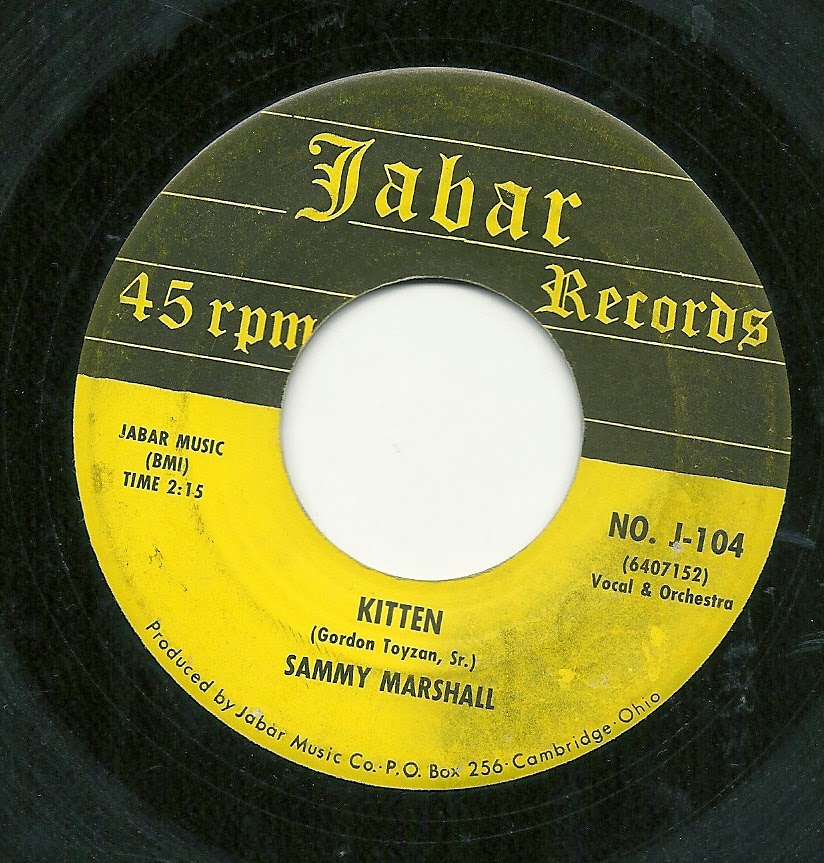
We haven't heard from Sammy Marshall lately, so I thought I'd remedy. Here's a slight, but enjoyable teener from the Jabar label of Ohio, via the Globe song-poem factory, titled "Kitten". The drum intro and initial guitar part seem (to me) to suggest something of a soul arrangement, which would be an interesting setting for Sammy, but then the sax comes in, and the record settles into a fairly typical early Globe groove. The words are cute, though, and right in Sammy's wheelhouse.
On the flip side, we again have Sammy Marshall, in another one of his typical settings, in this case, the country weeper. "One-Sided Love" doesn't do much, but I do get a kick of the fact that the bass player doesn't seem to have learned the chords, as he goes to sour notes at least four times over the course of the tracks, twice in the same spot each time the chorus comes around.
Today's record comes from the earliest days of Tin Pan Alley as a record label. Given that they gave double numbers to their early releases, it looks like this - # 111/112 - was likely their sixth release, probably from 1954 or 1955.
Like many early TPA records, there's a sheen of professionalism lurking about the edges of "How Many Times?", by the team of Teddy Ronson and the Al Lombardy Orchestra (all of whom disappeared from the label by 1956). The song could just as well have been a stab at a legitimate hit (however unlikely that might have been, given the quality of the vocal, but then, a ton of horrid vocalists were having hits in 1954).
The highlight of the record for me, though, is the drummer's rim shots, which provide frequent exclamation points to the proceedings. It would be enough to say that they don't seem to fit the song well - particularly one which says "DON'T slam the door" in its lyrics, but the man on the snare also seems to have not mastered the ability to know when to hit a rim shot, as they recur at seemingly random, sometimes in the middle of a musical phrase. A minor pleasure to hear, to be sure, but it makes me laugh...
The two most remarkable things about the flip side, "For a While I'll Remember" are its surprisingly short length (just 88 seconds), and the fact that when they made the record, they allowed the tape to ramp up to speed on the first note, leading the dramatic opening piano note to lurch up into the correct key. I can just hear someone say, "Ah, they won't notice - leave it that way" - that is, if they even bothered to listen to the pressing.
Today's post is a continuation of last week's celebration of St. Valentine's Day, which of course is tomorrow. And here to look at the holiday from an unusual, rarely considered angle, is Rodd Keith, in his Film City/Rod Rogers days. Showing up on yellow vinyl, as seen above and below, "If Cupid Went on Strike" is a midtempo number, with some interesting Chamberlin voicing choices and lyrics which use the word "bitsy" four or five times, which is four or five times too much. Hopefully, the cruddy condition of this record doesn't impact your enjoyment:
The flip side "Can't You Spare Another Kiss", features another nice Chamberlin track (with a brief "clarinet" duet, at one point), and lyrics which also fit nicely into the Valentine's Day. One mildly interesting thing about this record is that while "Cupid" is credited to Rod Rogers and the Swinging Strings, "Another Kiss" is credited to "Rod Rogers with the Swinging Strings". Maybe "odd" is a better word for that observation than "interesting"...
The recent travelogue we've been on will be put on hold for at least the next two weeks, while I offer up my annual tribute to St. Valentine's Day. And what lucky young person wouldn't feel lightheaded and start to faint at the thought of being serenaded by Sterling's own smooth singing Norm Burns?
Here's Norm, with a tender waltz sung to his one-and-only, "My Lovely, Lovely Valentine". It seems very likely that Ruth Ekey wrote this song as a tribute to her husband (or husband-to-be), and I do wonder when I see such a name on a lyric, what the song-poet thought when she heard a male voice singing her song. Ah, well, hopefully Ruth and her beloved were captivated by Norm's dulcet tones.
As is sometimes the case when I offer up a seasonally appropriate song as the feature, the real winner is on the flip. In this case, I suspect that almost anyone reading and listening today will agree that "Democracy" is the more memorable of the two tunes on this 45.
I'm not saying "better", because I'm not that's the right adjective. "Weirder" certainly applies, as do several other words, including "unusually lengthy for a song-poem" - it's four minutes long! Rather than give a greatest-hits review of this unique set of lyrics and performance, I think I'll just let you enjoy it, enjoy it, enjoy it yourself. The more I hear this one, the more I think it might have been compilation worthy.
For my money, the best singer ever recorded, and that I've ever heard anywhere. No one comes close. His voice was the purest expression of joy, or sadness, or anger, or righteous indignation, or whatever else was called for. In addition, his singing was a natural extension of his speaking voice, unadorned by any embellishment, misguided training or showboating, and that's exactly the sort of singing we don't have enough of today. His voice is pure emotion, expressed directly. His voice is the sound of America. His voice is the sound of life being lived well.
And not only that, Pete was without question in my mind, the most important American musician of the 20th century. I'm not saying that based solely on his songwriting or performances - I wouldn't try to support that statement. What I mean is: looking at any prominent musician of the century, and the totality of what each of them did, in all areas, musical or otherwise, again, no one comes close. He was one of the most important Americans of the century, period.
My main intent here is to share some of my favorite Pete Seeger tracks, and I'm going to start that right here, with a sidebar a few songs down. For the most part, I'm not going to focus on the most famous songs Pete is associated with - those can be found in myriad places - but instead will feature the lesser-known songs that he recorded that resonate the most with me, with a few exceptions in chronological order. I suspect I own close to, if not more than 95% of the recordings that Pete released, either in their original formats or re-releases. These are my favorites.
Before starting that chronological ride, I want to start with the recording I consider not only Pete Seeger's finest moment, but one of the two or three greatest single tracks ever recorded. This is one of those perfect records that I could listen to multiple times a day without getting tired of it. It's found on an album recorded at the Weavers' reunion concerts at Carnegie Hall in 1963, but aside from some key instrumental backing from other members of the group (the double bass in particular is essential here), this is all Pete's show, or rather, Pete Seeger with an choir-by-audience numbering in the thousands.
Listen to how simply Pete suggests they sing with him, going into the second chorus, and how, by the end of the song, it's a towering massed vocal singing with him. It helps that Tom Paxton's "Ramblin' Boy" is an incomparable song, but the magic here is what Pete does with it, with his singularly wonderful voice and with the audience.
Now it's time to step back a further 17 years or so from 1963. Next up is a song recorded for a tiny label in the mid-1940's, at around age 25, along with several of his lefty compatriots. "Listen, Mr. Bilbo" is, most directly, an indictment of a truly awful human being, Theodore Bilbo, who was concurrently a member of the U.S. Senate and of the Ku Klux Klan. But if you overlook the specific reference in the title, and adjust the lyrics to include what some today's consider to be "scary foreigners", this song could just as well be used as an indictment of xenophobia in general, and of any number of today's politicians. The energy and emotion on this record are just unbeatable.
The history of the Weavers, which Pete formed with three like-minded musicians, is well known to many, and easy to find for those who aren't aware of them. Suffice it to say that they became hugely popular in 1950, but by 1953 had broken up after becoming pariahs thanks to the witch-hunts of the McCarthy era. At the end of 1955, they regrouped and appeared in concert at Carnegie Hall. From that concert come the three incomparable performances below.
First, this musical trip "Around the World". I love the energy of this performance, the good spirits, and of course, the Weavers' magic vocals:
Then, one of the most gorgeous melodies I've ever heard, that of an Indonesian lullaby, "Suliram", made even more lovely by the Weavers trademark and unique harmonic blend. When Pete takes the lead vocal part way through, his voice is tender, sweet and intoxicatingly beautiful. If you have a chance, look up the translation to these words into English - they make me tear up every time.
And perhaps the most popular melody that Pete ever brought to the US, that of "Wimoweh", heard here in a fairly accurate (vocally, anyway) recreation of the original 1939 South African 78. The vocal blend in the section from 1:04 to 1:19 is just stop-me-in-my-tracks gorgeous.
The Weavers returned to recording after that concert, with Pete remaining a part of the group for about two years, until he quit in disgust after the other three voted to sign on to sing a cigarette commercial (which ended up never being used, anyway). During that time, they made some wonderful studio and concert recordings. This is a favorite, a duet between Pete and Ronnie Gilbert on "The Wild Goose Grasses", with more of those amazing harmonies on the choruses:
While making periodic recordings and concert appearances with the Weavers, Pete recorded extensively on his own, both in the studio and in live performance. Folkways Records released dozens of Seeger albums during the '50's and early '60's, sometimes more than a half-dozen a year. From one of those albums, here's one of my favorite of Pete's overtly political records, a union shouter, recorded with a chorus of friends, including a young Mary Travers, "We Shall Not Be Moved":
Many of the remaining live tracks, below, display the thing about about seeing Pete Seeger in concert that many fans loved the most - his ability to get a crowd of people singing together, often in three part harmony, and his near insistence that those in attendance give it a try. At best, this resulted in soul-affirming moments of beauty, and even breathtakingly gorgeous choral sounds. The track I posted at the top, "Ramblin' Boy" is a wonderful example of Pete's voice with a audience full of singers, but there are many other great recordings of this type, as well.
The following track, "Deep Blue Sea", is the first track on the first Pete Seeger solo album I bought. The recording quality is relatively poor, but the performance shines through, including a great and unusual exhortation from the singer, a dejected "I hardly hear ya", which works wonders at getting the reluctant to start singing:
At some point in the 1950's, Folkways Records released a multi-artist boxed set of "Songs of the Civil War". From that set come two songs which each contain one of my favorite Seeger vocals. First, this rousing version of "John Brown's Body":
And this gorgeous, achingly touching rendition of "Tenting Tonight":
A sidebar here.
It is worth noting - no, it is required to note here - that, while almost all of what I've shared so far was being recorded - indeed, while Pete made at least five albums with the Weavers, and perhaps three dozen albums for Folkways, including hundreds of tracks, he was, the entire time, facing the wrath of the U.S. Government, including what seemed likely to be a likely prison term, essentially for refusing to reveal his private thoughts.
Indeed, the most significant moment of his life I can revisit is what happened when he appeared before the House Un-American Activities Committee, to answer charges that he was a communist, among other things.
Many others had cowardly turned over names of friends and former friends to the committee, while even more had reasonably taken the fifth, which had imperiled if not ended their careers. Pete took a riskier, and flat out ballsier step, one I don't believe anyone else took - he essentially pleaded the First Amendment, telling the panel that, as an American, he had the right to believe whatever he wanted to, and in addition, was entitled to be free from the need to be compelled to reveal those thoughts in such a situation as he was then in. Basically, he told the committee that, under the constitution, his beliefs were none of their business. In 1950's America, those were daring things to say. Read his entire testimony here - it is bracing.
And for this, facing the charges brought, he could have faced a decade in prison - he was actually found guilty and sentenced, although the ten counts of one year each were to be served concurrently - and was under the threat of this sentence for nearly half a decade. It's a good thing he didn't have to serve this term in prison, but a shame that the case was thrown out on a technicality, as it might have been (had it been decided correctly) a nice precedent to prevent or halt similar Congressional abuses in the future.
But all of that was going on while Pete toured the country, spreading the word that through music can come peace and brotherhood, and, not coincidentally, being the key figure in the flowering of the folk revival of that era in the process.
And now, back to the countdown.
In the early 1960's, Pete Seeger was signed to Columbia Records, and he remained there for a decade. Buried in the middle of an otherwise typically vocal album from early in that tenure, was one of the loveliest pieces of guitar music I've ever heard. I spent years trying to learn to play even a fumbling version of this twelve-string masterpiece, "Living in the Country":
Pete's most famous non-Weavers album is undoubtedly the one recorded at Carnegie Hall in 1963. The entire album could be highlighted here, but this is one of my favorite moments, a song sung with a group of young "Freedom Singers", and capturing various political issues of the moment, "If You Miss Me At the Back of the Bus":
Around the same time as that recording, a performance at the Newport Folk Festival was captured, and this song from the concert was released. To me, it is among the prime examples of Pete's ability to lead a crowd in group harmony - as he first encourages them to sing, then goes over each part, then, realizing it should be in a higher key, moves his capo before launching into an inspired rendition of "Oh, Mary, Don't You Weep". The spoken opening is a great demonstration of how Pete's singing voice was just an extension of his way of speaking, and the moments here in which he sings a single high note over the harmonizing audience... well, that's something he often did, and it was always an amazing sound, rarely better than it is here.
As the battles of the '60's were fading into history, and the Vietnam War was winding down, Pete released his final album for Columbia. This track was little noticed at the time (indeed, as was the entire album), and it's very telling to realize how much stronger the reaction might have been if Pete had released his bouncy little tribute to the wisdom of Ho Chi Minh in 1968, rather than in 1973. As it is, "Uncle Ho" still contains a lesson which the US (as well as other governments) still refuses to learn, "If a Man Will Stand for His Own Land, He's Got the Strength of Ten".
In 1980, Pete released a full concert on a three record set, a concert and album package meant to demonstrate the art of leading the singalong. This is Pete's greatest album by a wide margin, and it reaches its zenith on the following song, where Pete turns an auditorium full of strangers into a full throated choir, singing in many-part harmony, until Pete is simply accompanying them on his guitar. The last few moments of "Run Come See the Sun" are perhaps the most sublime in Pete's entire catalog, despite barely even featuring his wonderful voice. If the sound of this track doesn't move you, then I'm not sure you and I have the same definition of "music".
Around 1984, Pete joined forces with Ronnie Gilbert, Arlo Guthrie and Holly Near, formed their first initials into the group name HARP, and played a few shows under that name. From the ensuing album comes another sweet singalong. The key moment here comes near the end - and I won't spoil the surprise - after Pete observes that once you've really learned the song, the song's almost over, he makes a more touching comment. Here's "Somos El Barco":
To my mind, no collection of Pete Seeger tracks would be complete without one of his performances of "Abiyoyo". Taking a traditional African song as its start, Pete built around this tune a story of how a boy who only wanted to sing was banished from his land, until that far off land was threatened by an ogre, at which point the boy and his father triumphed over the ogre with music and a little magic. Replace the boy with Pete himself, and the ogre with the witch-hunting McCarthyites and HUAC, and what you have in essence is Pete's own story. This is the version of the story that my kids always preferred, from a performance in the early 1990's, when Pete had perfected the story and told it with just the right amounts of scariness, tenseness and, later, joy:
And finally, moving back to 1974, here's my second favorite Seeger track, a performance with his great friend Fred Hellerman on the folk standard "Banks of Marble". The track here, with banjo, guitar and piano, goes into a rolling rhythm, as their voices harmonize as in the old days, and they sing a song which is, sadly, yet to lose its meaning - it is as relevant today as when it was written, about 65 years ago. To quote a well known Seeger song: "when will we ever learn?".
Well, not quite finally. I'd like to pay my own vocal tribute to Pete. Of all the songs I learned from Pete, this is the one I have sung the most often. It's not one of his own songs - it's called "Way Out There", and it was written by Bob Nolan of the Sons of the Pioneers, and I learned it from an album Pete did with Arlo Guthrie. This spur of the moment performance is from 1990, and features my great pal Stu and me. After some initial silly comments heard at the start, we get right into the song, and aside from a few lyrical flubs, I think it's a rather nice performance.
And here's my prized possession - a photographic memento of one of the two times I got to have a conversation with Pete, in this case in the late 1990's, following a folk festival fundraiser which had gone on about four hours (hence the glazed look in my eyes...).
Thanks, Pete, for the myriad ways that you colored our lives, made it a more beautiful, musical world, help open our eyes to so many things, and worked to make America and the world a better place. And in a more personal note, I simply can't imagine how my life would have been different, although I know it would have been for the much worse, had I not come to find you, your music, and your life story. Thanks.
Our trip to locations around the world continues today with a delightful trip to Italy with our one-man-band friend who for a time was known as "The Real Pros". I've no doubt that, when this conglomeration is mentioned, most song-poem collectors think of the glory days of the MSR crew, who, on their days off from MSR, took over the anonymous role of Cinema's "Real Pros" by about 1973.
But as I've said before, I'm much partial to the nameless man who's work is featured on the earliest Cinema sides. He sounds a bit like Gene Marshall at times (and, as friends have noted, he sometimes sounds like your humble blogger my own self), and he's usually accompanied solely by one of those all-in-one keyboards which were so common 40 years ago (although not, as you'll hear, on this record, where there is a guitarist present).
This record also has the distinction of having the lowest label number of any Cinema release yet documented, even lower than this truly atrocious release.
All that is sort of besides the point, but I guess I like to type. The real news is that this record, "Fun in Napoli", is a truly enjoyable little ditty, with corny but good natured lyrics, sung in a stereotypical accent which might be obnoxious, were the entire enterprise not so fun and lighthearted. With Lou Monte, I tend to find this sort of thing unlistenable, but the lo-fi and low-tech nature of this record makes it irresistible to me.
The flip side of this record is called "The Magic of a Song", and while I can heartily agree that there is magic in many, many songs, including the one I just featured before this paragraph, I find none of that magic, or even interest, in this record, behind a minor bit of enjoyment in some of the guitar playing. Ah, well - it's probably asking too much to routinely find two songs to enjoy on one song-poem record.
Actually, one of the more interesting things about this record is the production credit, a rarity in itself on a song-poem record, but especially here, in that each side lists "the author" as a co-producer. A similar credit appears on that other early Cinema release I linked, above. That seems unlikely to begin with, but since the two songs were written by two different song-poets, it seems virtually impossible. I'm also intrigued by the credit to "Action Music" publishers, and wonder if that doesn't indicate a previously unknown link to the Fable/Film City family of labels, which had a subsidiary called "Action Records".
All of that speculation interests me considerably more than does "The Magic of a Song", but here it is, anyway:
I'm the father of two amazing young adults, married to the most wonderful woman in the world, and I work in the mental health field. I play several instruments and record my own music. I'm a long time record collector, hoarder of unusual, rare or unique recorded sound, musical, spoken word or other, and am glad to have found this outlet to share some of my favorite parts of it with others.