Wednesday, April 26, 2023

W. L. Horning Strikes Again!!

Today, I have a find which will no doubt be considered a very important find by a handful of collectors. And it will no doubt be considered extremely esoteric by everyone else. 

For those not in the know, I wish to introduce you to W. L. Horning, maker of some of the most astonishingly bad records in the history of bad records. 

If, indeed, you are not familiar with Mr. Horning, please know that he made two confirmed records under his own name, an EP of four songs, and an EP of six songs. One of the songs, Kiss Me, Kiss Me Baby, can be heard here, and has to be heard to be believed. 

But then, Mr. Horning took the backing track for "Kiss Me, Kiss Me Baby", sped it up, and made up a new song by expressing himself ("singing" seems like the wrong word") over the sped up track. Unfortunately, "Kiss Me Kiss Me Baby" is only 63 seconds long, and the new song, "Rockin' and Rollin'", is almost three minutes long, so he kept moving the needle back in order to emote over it so more. The results are truly one of the oddest things ever pressed into plastic - and off center, to boot. 

The great Darryl Bullock, in his book on the World's Worst Records, has written about Mr. Horning, and while this segment can be found online, I encourage you to buy his books, which are wonderful. 

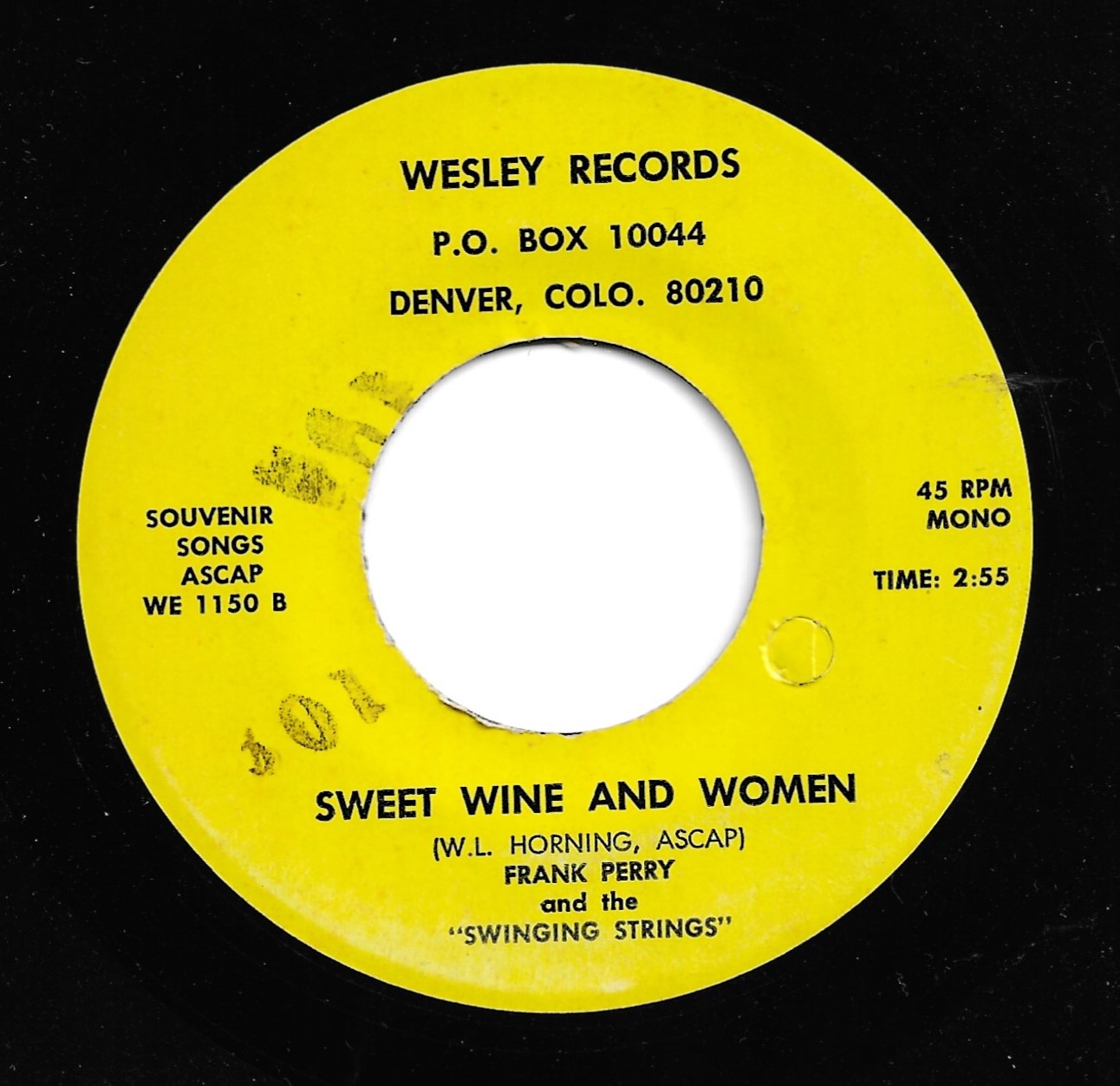
In the late 1970's, probably after those records were made, W. L. Horning began utilizing the facilities of Sandy Stanton's song-poem factory, and sent his "songs" to Stanton for a more professional result, pressed up on the custom (vanity) Wesley Records label (Wesley being the W in W. L. Horning's name). When the song-poem website was mothballed, only three singles (and six songs) from Mr. Horning's pen were known to have been recorded, and a fourth record turned up as an entry on the 45Cat website some time later. 

Well now, all of you get to hear that record, as recorded by Stanton favorite Frank Perry, and the ever-present "Swinging Strings":


We'll start with a previously unrecorded song from the maestro (several of his Wesley releases were remakes of songs he himself had already recorded). This one is called "Sweet Wine and Women", and like everything he wrote, it has lyrics which are simplistic to the point of ridiculousness. 

Play:

On the flip side is one of those recordings where Mr. Horning had Stanton's crew remake one of the songs he had already recorded. The Horning version used to be available online, but I've been unable to find it now. The song is "Summer is Gone". 

Play:


Wednesday, April 19, 2023

There's Nothing Better Than Salt!

Greetings, y'all, 

I am desperately late in posting something called Song-Poem of the Week. but in my defense, I spent nearly all of my free time in the past month writing a massive post (for my other blog) to honor the 100th anniversary of my mother's birth, which occurred last Sunday. The post is indeed massive - several thousand words, about 18 images and 24 sound files - and I understand if those reading this site choose not to dive in. But if you're at all interested, I'd be honored if you'd read it. It's a good story. You can find that post here

To make up for the delay, I have a record today which is most certainly my favorite new-to-me song poem in a long, long time, at least since I posted "That's the Life For Me", last May. It's a song by Sammy Marshall and it's all about that most important of subjects, SALT. And if you don't think that I consider SALT to be important, than you don't know me very well. 

What's more, "Salt, Salt, Salt" has a bouncy, fun, early '60's arrangement, a wonderful, ragtime style piano break (I am reminded, just a bit, of "Green Door" by Jim Lowe, one of my favorite records ever) . It also has really clever lyrics. In the early lines, the song-poem team that put this lyric together quite accurately identify many of the things that make salt essential, and accurately identify that one cannot live without a lot of salt. I know I can't. By the middle and last verses of the song, they are ascribing all manner of amazing things that salt will allow you to do, including making you rich and allowing you to patch up arguments. I don't know that this is true, but given how wonderful salt is, I wouldn't rule it out. 

Just an all around wonderful record. 

Download: Sammy Marshall - Salt, Salt, Salt

Play:

The flip side, "If You Should Ever Say Goodbye", is what Billboard would have probably called a "rock-a-ballad" in 1961, which is apparently when this record is from. Sammy seems a little shakier on this vocal than I'm used to from him, and it's okay all the way around, I suppose, without being anything special. 

Download: Sammy Marshall - If You Should Ever Say Goodbye

Play:

Please also note that this is the only known song-poem release on the Carol label. There is one more Carol release listed on Discogs, but that one is clearly not a song poem, and has enough things different about it that, despite the label logo being the same, I suspect the two records are unrelated. 


Friday, March 31, 2023

A Tale of Two Demos

 Greetings, song-poem fans!

First up, I would like to acknowledge by best friend Stu, who is the most frequent poster here, I do believe, and who, earlier this week, had one of those big round birthday numbers. Happy Birthday, Stu!!!

And then, I want to mention Sammy Reed, perhaps the second (if not the first) most frequent poster here. Sammy recently discontinued his blogspot site, meaning that a whole lot of comments on my posts had links which went nowhere. I have changed several of those today, to go to his new site. Most of those links now go to a massive post where he has included virtually everything that he previously uploaded in response to, or in anyway related to, this site. I could direct you to all those individual posts, but most of them link to this page

But in addition to that, Sammy remembered a post I wrote nearly a year ago, in which I commented that I'd found a copyright entry for a song called "HOOPA LOOPA HOOPA LOOPA DOOPA", and I commented that I'd pay to hear that song.

Well, sure enough, Sammy has found that song on YouTube, with a somewhat simplified title. I can't say it lived up to my hopes, but should also note that the chorus did repeat in my head for hours afterward. On a side note, if that's Ruth Brown I'll eat my hat. "Venus" can't even stay on pitch.  Thanks, Sammy - where do I send the check?   

And now: 


Over two months ago, I wrote, rather excitedly, about having found two Cara Stewart acetates that I'd bought somewhere along the line and had completely forgotten about. I shared a two sided acetate at that time, including a wonderful tune called "I Just Dropped In to Say 'Hello'"

Today, I have the other acetate. This one is one-sided, and it is written by the same team that wrote both of the songs on the other acetate. Like the other disk, this one came with sheet music, seen here: 

The song, "Don't You Think We Better Dance", isn't much musically, but the lyrics hint at something considerably more steamy than the typical song of the era, without getting into details. And of course, Lee Hudson's arrangement and Cara's warm, inviting singing make it something well worth hearing. 

Download: Cara Stewart - Don't You Think We Better Dance

Play:

The label on that record makes it clear that the recording is a demo, rather than a completed product sent to the song-poets (or in this case, songwriting team). But the care and effort evident in the performance take it well beyond the average demo. 

I didn't want to just share one track, so I pulled out another one sided song-poem demo 78, not only to give you a good deal in reward for stopping by, but also to contrast what a demo from most song-poem outfits sounded like: Dull as dishwater. 

Here's a record on the previously unrepresented (here) Hollywood Tunesmiths label. The song is "Laura Lee", and it features a nondescript male singer accompanied, boringly so, by piano backing. I find everything about this record bland, and it makes it just that much more impressive to hear what Lee Hudson was doing for his customers, most likely just a few years after this record was made. 

Download: No Artist Named (Hollywood Tunesmiths) - Laura Lee

Play:


Wednesday, March 22, 2023

It's So Easy To Be Breezy!


It's been way too long since I posted here- I've been sick the last several days. And there are updates I need to do to some previous posts, as well, but they will wait until next time, as I'm still not doing great. In fact, I'm going to quote from myself in presenting this duo of Fable sides. But first, it's worth noting that the AS/PMA page shows that Fable records numbering started with the 500's, and one other online repository shows a single additional record from the 200 series. So I'm not sure when this is from - it's either just about the first Fable release or some sort of outlier. 

Anyway, here's what I wrote about the label, and this particular lyricist and perhaps songwriter, just about five years ago: 

As I've written before, posting songs from the Fable Label poses an interesting dilemma. Most of the songs on the label were probably not song-poems, but a good percentage of them seem to have been vanity releases. And when a likely vanity release is sung by someone other than the song-writer, that seems like at the very least a hybrid vanity/song-poem release.

Such is the case - and I'm guessing here - with today's feature. Lysle Tomerlin had several songs released on Fable, and wrote at least one South-Pacific-Themed song which was recorded and released by an established artist. Aside from that song, though, everything seems to have been on Fable, making me suspect these as vanity records.

I wrote those words about a record of two Western Swing numbers, by Little Jeannie Greer, and this record, featuring two different female singers, also falls under that genre. The better of the two, and quite catchy, to my ears, is "It's Easy to Be Breezy", sung by Joan Allen (presumably not the Oscar nominated actress of the same name, who was not yet born when this record is likely to have come out), accompanied by a real mouthful of a band, Sandy Stanton and his Rhythm Ranchhands. 

Play:

The flip side is by Lee Esmont (presumably not the Oscar nominated actress of the same name, because there isn't one),with a slower, and less interesting number, titled Stepping Stones. Here and there, the guitarist (at least when he's playing while Lee sings), seems to have thought he had the chops and style of Les Paul. He didn't. No one did except Les. 

Play:

So are these song-poems? Vanity recordings? Something else? I'm really not sure, but in the case of Fable, my goal is simply to share whatever previously unavailable finds I make. And this one seems to have been unknown, before this point. 


Saturday, March 11, 2023

Dora Foley Has Something to Say


Today, I have one of Rodd Keith's earliest song-poem releases, just the 41st (or so) entry on his first label, Film City (and, of course, not all of those 41 (or so) were even Rodd Keith records. That was what I initial found to be most interesting about this record. But once I listened closer to it, I found something else of even more interest. 

For this record's lyricist, Dora Foley, clearly knew hew way around writing. The lyrics to "Don't Cry Too Loud" are an extremely effective character study AND a put down of a former lover. Now, I will add that I don't necessarily think that the words to "Don't Cry Too Loud" were all that great of a match for a musical backing. Consider this couplet, probably the one really ill conceived line in the piece: 

You're so blasé now 

with all your drinking

There's only so much that even Rodd Keith could do with that. And he did attach it to a pretty durn turgid setting (one thing the "strings" on this track are not doing is "swinging"). But as a piece of poetry and a put down, I quite enjoyed Ms. Foley's composition. 

Download: Rod Rogers with the Swinging Strings - Don't Cry Too Loud

Play:

The flip side, also written by Ms. Foley, contains a lyric which is much more suited to a musical backing, at lteast to these ears. And again, I think this is a fairly good little set of lyrics. Fleshed out with a few more verses, I think one would be hard pressed to discern these words as being those of a song-poem submission, as opposed to those from a record meant to be plugged as a potential hit. Note that I'm speaking of the lyrics here, and not the fairly cookie-cutter (and mechanized) supper club backing that Rodd provided for it. 

And hey, here's another one of those records which fades out, but then ends before the fade out is complete!

Download: Rod Rogers with the Swinging Strings - Mine to Forget

Play:


Sunday, February 26, 2023

More Old Time Religion

Wow, can it really be four months (to the day!) that I featured Sammy Marshall? I'm gonna guess there's never been that much of a gap between Sammy records before, on this site. 

And this also gives me a chance to revisit, once again, song-poet extraordinaire Edith Hopkins. As I've written before, Edith Hopkins wrote several songs which appeared on the "Carellen" label, an outfit that appears to have provided vanity pressings and semi-legit releases for a number of songwriters and performers. But she then created her own label, "Inner-Glo", and utilized the folks at Globe and at Film City, as well as other performers, to perform her songs on that label. 

I have heard from members of her family over the years, and they have confirmed my suspicion she was the composer of her songs; that is, that she wrote the words AND the music for the songs which carried her name, unlike a 100% song-poem where someone at the song-poem factory wrote the music. So her releases sort of cross the song-poem/vanity line, at least on those records where someone like Sammy Marshall (or, as he's identified here, Sonny Marcell) is performing her work. Other releases were likely attempts to market actual potential hit records. 

For my money, Edith Hopkins was one of the best writers working within the environs of song-poems. Examples abound, but here are two: one from my site, and one which is available on YouTube. Oh, and there is the little matter about how she wrote my favorite record - by a country mile - that ever came out of anything even adjacent to the song-poem/vanity world. The first bridge of that record is quite likely my favorite 15 seconds ever record. Ever.

Anyway....

Today it's another religious song from the pen of Ms. Hopkins, appropriate, as it turns out, for the first week of Lent, I suppose, but that's a coincidence - the appeal to me here is the bouncy track and the engaging and warm vocals, not the lyrics (although they're quite effective, too). It's got the clunky title "Hurry Lord God, Reach Down For Me", and I'm guessing that no song-poem ever had more commas in a title. Something dreary could easily have been made out of this, and if so, I wouldn't be featuring it. But happily, it's a country pop groove, which becomes more and more gospelly as it goes along, what with the handclaps and the wailing soprano in the final minute. And, like so many of her songs, it's a capably written song, with effect lyrics and a really good melody (although I must admit that the words of the last verse, which touch on the crucifixion, sound more than a bit weird  when combined with this peppy, upbeat music. 

Download: Sonny Marcell - Hurry Lord God, Reach Down For Me

Play:

~~

Well, they can't all be winners. On the flip side we find "Just a Whisper". Musically, this is professionally done, and Sammy Marshall rather gave anything less than his all. But aside from a few minor pleasures (I like the harmonies), it's a pretty dang dull effort. 

By the way, for those who might be interested, this record is from 1962. 

Download: Sonny Marcell - Just a Whisper

Play:


Monday, February 20, 2023

Norris Minus Norris

I am taking a bit of a road trip down what might be an off-ramp from the song-poem world today (or might not be). Because I can't confirm that today's offering is a song-poem. It probably isn't. But it's connected to that world. 

And what's more important to me, in this case, is to further the sharing of the wild, wonderful, odd world of Norridge Mayhams (aka "Norris the Troubadour). I assure you, every time I get a chance to share something previously unknown that Norridge touched, I'm going to share it. 

And the Co-Ed label of the 1940's was Norridge Mayhams' label. So, stepping away, possibly, from the song-poem realm into the vanity realm, here's today's offering, which I just took ownership of this week: 

"Light Up" is the feature here, and it's a jazzy, big band thing with a instrumental dance run-through leading to a vocal refrain, then back to another instrumental passage, just like a good percentage of the records from this era (ads for this song - albeit with a different flip side - appeared in multiple issues of Billboard in 1944). 

The vocal chorus is very likely the band members themselves, and they sing it in unison. It is, as you might imagine, a paean to the joys of smoking. The nature of the benefits of smoking listed here indicate to this listener that the songwriter did not have tobacco in mind. 

The performers are The Ministers of Melody, who appeared on at least a few other Co-Ed releases, including one I featured before

Download: The Ministers of Melody - Light Up

Play:

In fact, that aforementioned previous Co-Ed release I just mentioned, the one which also carried the name of The Ministers of Melody, contained the exact same song and performance (same label number, too) and that which appears on the flip side of this 78. This also happened with "Light Up", which showed up on the flip side of something called "Induction Blues" in a different release, and on the flip side of a version of "From Hopewell Junction", which is the song I shared in that other long ago post I just referred to. 

Anyway, although I shared this once before, 14 years ago, here's "Married Man Blues". I think this record of it is actually in slightly better quality than the one I shared in 2009

Trying to figure out the where's, what's and why's of Norris the Troubadours career and making sense of his label releases is quite a challenge. So what's the Norris connection here? Damned if I know - could be that he just knew whoever was behind this band, and it could be that he knew the composer (Lowe) of both songs, making it, as I posited, a vanity record. Could be none of the above. Just one more piece of the puzzle, which I'm happy to provide today. 

Download: The Ministers of Melody - Married Man Blues

Play:


Sunday, February 12, 2023

Bobbin', Rockin' and Beboppin'

 Hello, 

Before we get to today's feature, a bit of housekeeping. Regarding my last post, about Lt. Calley, I received a nice note back from Jason Brummer, of The Vietnam War Song Project, who offered up a correction. I had directed folks to see # 36 on that list, for a posting about the Gene Marshall record I was featuring. However, it turns out that the song-poet submitted both songs on that record twice, with the Calley song actually having different lyrics each time. The song I posted is on Jason's list, but it is at # 77. 

Also, I encourage you to visit that same post, and read the comments from "Doctor Future", who linked to yet another Calley record (as well as to a song about sewers exploding). 

Finally, Sammy Reed dropped by to explain that he has closed down his blogspot site, which I have linked to many times, and which is in my feebly small links box. He has opened a new site, and has promised to re-populate it with many of the records from the old site, but, sadly, none of the links in my previous posts will now work. I have changed the link in the links box to his current site, and encourage everyone to check it out!

And now, on with the countdown:

~~

I think today's first tune is a lot of fun, and hope you do, too. 

But first, to understand today's record, you must first be familiar with a 1920's hit song called "When the Red, Red Robin Comes Bob, Bob, Bobbin' Along". It was a hit in 1926, and again in 1953. A knock of of the 1953 hit was produced for Little Golden Records, and that's the version I grew up being familiar with. 

Well, in 1961, a song-poet decided to update the story, spelling the word "Robin" wrong in the process (unless that was the fault of the person who put the label together), and giving us "The Red Robbin Ain't Bobbin' No Mo'" And lucky us, it was assigned to Tin Pan Alley's Phil Celia, who made far more than his share of oddities during his time with the label. 

For exactly 90 seconds, our song-poet friend lets us know that the robin (sorry, the robbin) has moved on from his "Bobbin'" style and has embraced both Rock and Roll and Bebop - a dual move into two styles which had absolutely nothing in common, and which seems highly unlikely. But maybe birds (sorry, birrds) are more flexible in their musical genres than humans. 

Helpfully, the folks in the Tin Pan Alley band put together a backing track which contains no elements of Rock and Roll or Bebop. Or Bebbop 

Download: Phil Celia: The Red Robbin Ain't Bobbin' No Mo'

Play:


I have nothing even remotely good to say about the tedium found on the flip side, "My Love Never Changes". This inexecrable slab is exactly one minute longer than "Bobbin", but seems about two years longer. Phil appears to be channeling the most unctuous and smarmy of Paul Anka then-contemporary performances, and that's really saying something. 

The opening two lines should give you an idea of the quality of the lyrics: 

My love never changes
My love stays the same

Well, as this seems to have been created as a sort of performance/proposal, I hope the writer's intended said yes. Or maybe "Yes, if you promise to never play that record again". 

Play:


Saturday, January 28, 2023

Oh, Good, ANOTHER Song Supporting Lt. William Calley

 First up, I have a few links to share, courtesy of two frequent correspondents. 

First, some of you may remember this posting of an ultra weird song called "My Doll Jane" from 2015. Well, ace collector and blogger Sammy Reed has discovered a remake of the song on the flipside in that posting. When I posted "Helen Goodnight", I commented that Gene Marshall makes a major melodic flub right at the point of the key change. 

Well, whether due to that flub, or some other reason, song-poet Helen Clak (too bad it wasn't "Helen Back") commissioned a remake of her song several years later, near the end of Preview's existence. Whether this was because of Gene's flub or some other reason, I certainly don't know - it's the same song, though, same melody and everything. Sammy's posting can be found here

And then, from the "I absolutely did not see that coming" file, I have an e-mail by ace song-poem detective Bruce Baryla. You might remember that he came up with the definitive answer to all those questions about Bob Storm some time ago. In this case, Bruce has discovered information about Rosalee Baker, who turned up on a single known Tin Pan Alley release, which I featured here. Well, Bruce has deduced, from a series of online sources, that Rosalee Baker was the first wife of the great guitarist (and early Tin Pan Alley sideman) Mickey Baker, and would have been his ex-wife by the time of her Tin Pan Alley. Among other sources, he has found her obituary here, and also sent me a quote from a 1957 edition of Jet Magazine: 

Rosalee Baker, estranged wife of Mickey Baker of the Mickey and
Sylvia song team, auditioned for a dancer’s role in Lena Horne’s new
Broadway musical, Jamaica."

Fascinating stuff, both of you. The song-poem world is a deeply mysterious and many layered thing, and I love finding out more information from its nooks and crannies. 

And now, let's get back to the countdown:

~~

As I may have written about. here or elsewhere, I spent a huge amount of my free time, in my early 20's, at the Northwestern University Music Library, painstakingly copying down the top 40 charts (and those which came before them, back to 1940), by hand, and at times, studying the rest of individual magazines as I paged through them. My friend Stu began accompanying me for a time, and I believe he was with me, when I saw a high entry on a 1971 chart called "The Battle Hymn of Lt. Calley" by C Company featuring Terry Nelson. The song marched into the top 40 at # 37 in its second week, as I recall, stayed there, and then quickly fell off the chart, appearing for a total of four weeks.. 

I'd never heard of Calley, but Stu filled me in on Calley's atrocious, appalling and downright horrific acts in Vietnam and his wholly appropriate conviction. In an issue of Billboard from the month that the song hit, I found a front page article about the controversy surrounding the record. We wondered about the song itself, but being that it was 1982 or so, had no real way to access it without a LOT of searching.

Some years later, my friend Tom and I actually found a copy of the record amongst literally hundreds of records we'd bought, when we purchased a "dime bin" full of 45's from a local used record store for about $50 (we did that about five times - those were the days). Upon hearing the opening narration about how Calley pretended to be a soldier from early childhood, Tom was absolutely certain that it was either satire or that it was going to be an aggressive putdown of the man in question. Having already read about the song, I assured him that, as ham-fisted and misguided as it was, the tribute and support on the record were meant to be sincere. 

You can read more about that record on this page of the Vietnam War Song Project, where there are 115 songs about My Lai and Lt. Calley listed, including today's feature. The hit song I've just mentioned is number 16 on that page's list, and it includes some of the comments from Billboard. My feature today can be found there, at number 36. 

Anyway, the thing is, what I really mean.... Gene Marshall was drafted into service to provide today's offering, "The Ballad of Lt. William Calley", a record which seems to exist mostly to get people to listen to the record that they're presumably already listening to. Gene narrates about 90% of the record, rather than singing, and the song-poet expresses the interesting viewpoint that only God can judge people - no doubt he felt the same way about those protesters in Chicago in 1968 and others whose behavior he disagreed with. No doubt. 

I really wish I could be in Gene Marshall's brain before, during and after the recording of this record. For a man who, by his own admission, let fly a string of obscenities after having to record a pro-Nixon record for Preview, I feel certain that he disagreed with every word he was singing... er, speaking, here. 

Download: Gene Marshall - The Ballad of Lt. William Calley

Play:

For what it's worth, and I'm sure to the horror of those misguided enough to consider him a hero, Calley did eventually publicly apologize for his actions. 

~~

If anything, the flip side, by the same song-poet, is the more entertaining of the two songs, if only because it contains about as many poorly written and difficult to sing couplets as any song I've ever heard. It's called "America is My Country". I'd call it half-assed, but that would be an insult to asses. And what's more, it throws in yet another reference, almost at random, to Lt. Calley. 

I'm particularly fond of this set of lines, which occur back to back:  

"We've got a Lieutenant / he's a man who treats us fair /

Yes, Sir, I'm from Oklahoma / And America's My Country /

Oh, kind folks and teenagers....."

 (note, the accent is on the second syllable of Country)

There's also this: 

"I've joined the army now, boys, and I'm working for THE government."

Download: Gene Marshall - America is My Country

Play:


Thursday, January 19, 2023

A Major Find - Cara At 78!

I have a real find for everyone today!

But before I get to that, a frequent correspondent, who I've mentioned before, Tyler, has made a real find of his own. Everyone first click on this link and read about an odd record on Halmark, which I shared nearly a decade ago. It features a song written by Halmark head dude Ted Rosen on one side, and a rendition of "By the Time I Get to Phoenix", listed under the wrong title and no writer credit on the flip side. 

The songs were performed by Barry Craig, and I presented it as a real outlier, without any clear understanding of what its backstory might be - although it certainly isn't a song poem record by any definition. 

Well, Tyler has found this article. It is a profile of Barry Craig from MUCH later in his career, and runs down the high points of that career, including the fact that he recorded his first release for Halmark back in 1968 - the very record I posted. My guess is that makes Craig's rendition of Ted Rosen's composition either an attempt by Halmark at an honest-to-goodness hit song (unlikely), or a vanity release for Mr. Craig, who was given the song by its author (more likely). The presence of a hit song on the flip side indicates to me that perhaps there was only one original composition available at that moment. 

There could of course be another explanation, and I'd love to hear what people thing. Thank you SO much, Tyler. 

~~

As readers of my other blog may have read, I have been divesting myself of the vast majority of the 100-150 acetates that I've collected over the years, only keeping those that I really treasure, including my relatively few song-poem acetates. Some sell, some don't. 

I thought I'd listened to, and listed, just about all of them, but over the weekend, I found a small stack of acetates stored quite a ways separate from where all the others had been. And that stack was full of several that I bought ages and ages ago, in a few different purchases, with considerable excitement, due to their apparent content. Somehow, upon receiving them, I put them away and forgot about them, which is really not like me. There must have been something else going on in my life at that moment. This literally may have been ten years ago!

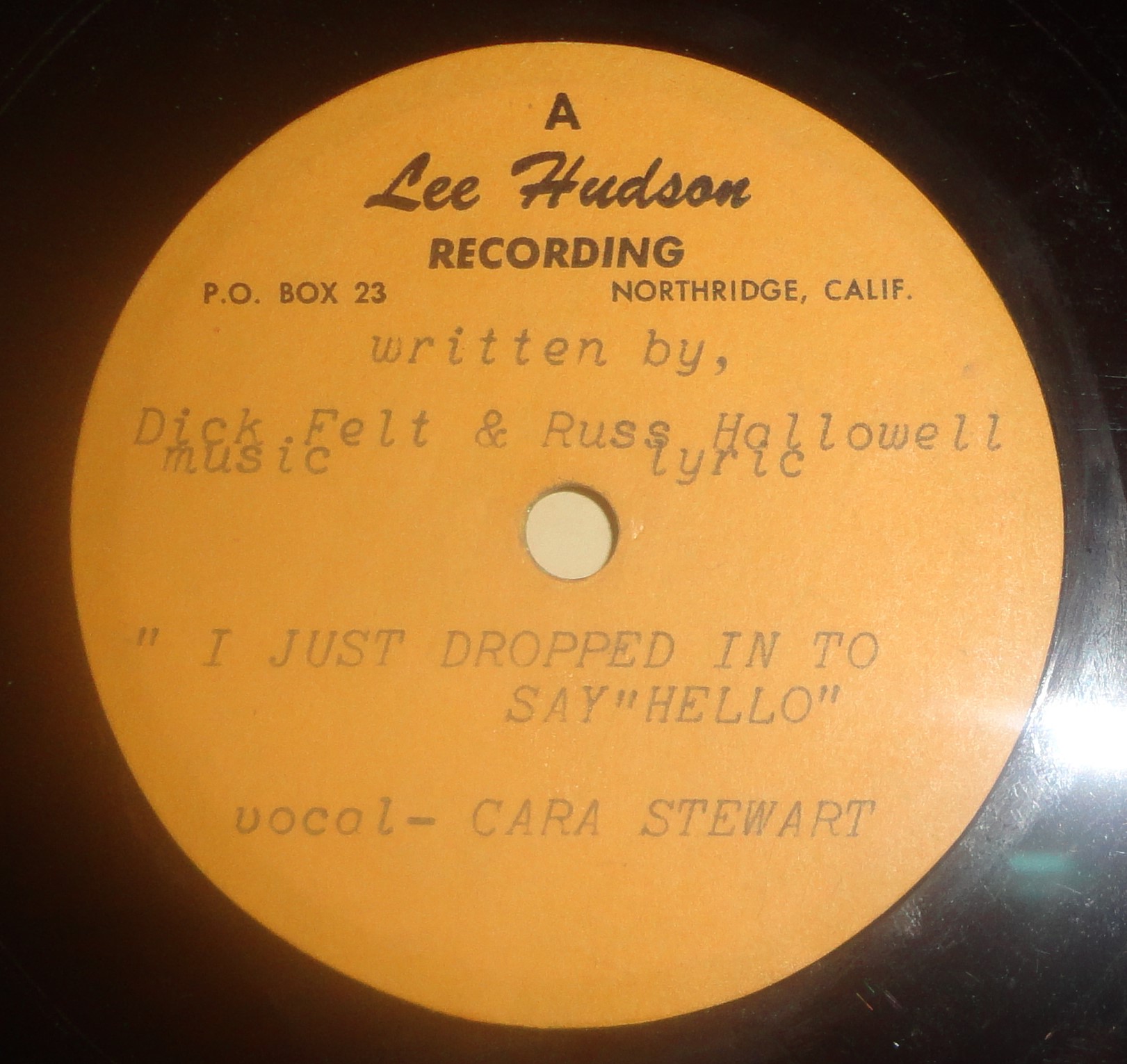
Anyway, the most exciting of them, to me, upon finding them again a few days ago, were two 78 RPM acetates sung by Cara Stewart, on a previously unseen label - "A Lee Hudson Recording". Lee Hudson obviously produced hundreds of song-poems, and often his name is prominent on those records. But these are the first I've seen where the label name contains his name. Even his AS/PMA page doesn't have any indication of records released on an eponymous label.  

What's more, one of the two songs is as winning a performance from Cara Stewart as you're likely to hear. The record looks like this. 


It's "I Just Dropped In to Say 'Hello'", and it is, admittedly, a wisp of a song, making it to 95 seconds only because a piano solo and a repeat of the bridge and chorus are tagged on - without those, the song probably would barely break a minute. But I LOVE this. Was anyone in the song-poem world ever better than Cara is here? 

The credit to a team of writers (Dick Felt and Ross Hollowell, on both sides of the 78) indicated to me that perhaps this was a professional songwriting team, but an internet search has turned up nothing. 

Download: Cara Stewart - I Just Dropped In to Say "Hello"

Play:

These are obviously demos, what with just the piano and vocal, and also obviously acetates, as the  auditory damage apparent on the flip side, "The Biggest Fool in Town" will make clear. 

But this is the far less interesting of the two, to me, so at least the damaged side is the right one. 

Oh, and this record came to me with a lead sheet for "The Biggest Fool in Town" which is reproduced below, as well. 

Download: Cara Stewart - The Biggest Fool in Town

Play:


Tuesday, January 10, 2023

THE M.S.R. SWINGERS!!!

Hello, and HAPPY NEW YEAR!!!

Before getting to today's offering, I want to make sure I send all y'all to Sammy Reed's site for something quite interesting and off kilter. 

Nearly 14 years ago, in this post, I offered up a Tin Pan Alley single with the singularly unwieldly title "What Do You Say Baby Beautiful Joyce". 

What Sammy has found is a 45 on a custom (vanity) label, wherein the same song writer (well, let's assume "Frank Wilson" and "Fu Wilson" are the same person), teamed up with Joi Dibrango (which I'm assuming is someone's name, although it sounds like something a call-girl has on her menu of pleasures) to create the J..D..i..F..U label, and released a Preview-sounding recording of the same song. 

Gene Marshall's rendition (in which he is joined by a catchily named fake backing band) proves that it was probably impossible to set these lyrics to a catchy tune, and the flip side is worth the price of admission. Sammy's post is here, and I encourage all of you to take a quick jog over there when you're done here. 

~~

For my own presentation this week, I thought I'd kill three birds with one stone, or perhaps "destroy three Smashing Pumpkins records with a 200 pound lead needle" would be a better way to phrase it. 

Anyway, I'm not much of a fan of MSR in general, or Dick Kent in particular, so I don't share their work (together or separately) here very much, and I know there are people out there who dig their stuff. So I'm going to share Dick Kent and MSR. The third side aspect that I'm taking care of today is that the record below involves a consortium of artistes who seem to have only been credited on an MSR label once - at least that is documented. To wit: 


Yes, M.S.R. Swingers. 

In actuality, as you'll hear, it's just the usual yokels that played on MSR records, with a vocal by Dick Kent. Which in itself is odd, since he is featured on the flip side, as well. Perhaps the song-poet requested that the song be performed by a group - that's quite possible. But then, why pair it with a record that so obviously has the same singer credited solo on the flip side. Were they assuming that the song-poet was dumb enough not to notice? 

Who am I kidding? Of course they were thinking that. 

Anyway, I fully expected M.S.R. Swingers to, you know, swing. And I was sort of excited to hear it - it's a low number MSR release, from some time before their releases truly began to suck, across the board (your mileage may vary...). But it's a dreamy slow number, even lush in places, with a "closing-time-at-the-supper-club" feel to it that I expect plenty of you will dig. Far more than I do, anyway. But "swing" it most certainly does not. 

It's also over four minutes long, and certainly feels it. 

Anyway, for the second post in a row, it pleases me greatly, Ladies and Gentlemen, to present a previously unheard song-poem artist (or, in this case, group). I give you.... M.S.R. SWINGERS!!!


Play: 

~~

As I said, the flip side is clearly the same band and the same singer, in this case, labeled as Dick Kent, and the song is "Song to September", which features what I think might be an early synthesizer bleating out a tinny, high pitched backing throughout, one which hurts my ears and threatens at times to overwhelm the rest of the backing. Blech.  

Play:


Friday, December 30, 2022

Frank Manell's Greatest Hit

Before I get to this week's record, I want to share that I have updated a posting from two weeks ago, in which I had somehow forgotten to add the label scans. That was especially important, as this was the first time I had shared a record on that label. They are there now. 

Ladies and Gentlemen, I give you, Frank Manell: 

When I first played this record, I knew I wanted to feature it very soon in a post, but I also thought it was one of the many cases where a song-poem company mislabeled the artist on a 45. Because the record shows the performer to be Frank Manell, and I was sure the singer of this song was a woman. 

It wasn't until I listened to the flip side that I realized that Frank Manell was a male singer who possessed a very high tenor, sort of a song-poem Clyde McPhatter. 

Not only that, but the song ("Diamonds and Rubies") is bouncy, energetic and winning all the way around, as is Mr. Manell's vocal. I find this record pretty irresistible. The TPA folks again demonstrate that, unlike many of the other companies, they were well aware of the styles and trends in music, and made their records sound like the hits of the day, the day in this case being 1957. The guitar during the bridge, in particular, sounds like it was lifted from any number of early Elvis records. The weird drop out just before the sax solo (which is part of the record, and not a error made in digitizing) is the only flaw here.

So who was Frank Manell? Danged if I know. He is only listed on the AS/PMA website on one record - this one - and Discogs has one more listing, for the release immediately before this one ("Having a Gay Time"). Then he disappears into whatever ether he arrived from. But he surely left us better than we were before he arrived, because this is a wonderful record. 

Download: Frank Manell - Diamonds and Rubies

Play:

Sadly, I cannot work up any enthusiasm whatsoever for the flip side, "My Treasures", a dirge of an arrangement which buries any charms that might have been from the words or the vocal. The song is 30 seconds longer than "Diamonds and Rubies", and seems five times as long. 

But I will say that Mr. Manell continues to impress with his vocal prowess, with the exception of a tendency to over-enunciate some words to the point of mispronunciation, much in the way Nat (King) Cole tended to do. 

Download: Frank Manell - My Treasures

Play:


HAPPY NEW YEAR, EVERYBODY!!!!