Thursday, September 27, 2012

A Lutone Record... Maybe the Only Lutone Record


Like several of the larger song-poem companies, Film City would allow its products to be "released" on vanity labels, most of which tended to be tied to the individual song-poets whose materials would show up on those labels. Here we have one of the tiniest - Lutone Records, named for the writer of the songs, Luton Stinson, who interestingly, is listed as writing both the words and music of both songs, the latter being a real rarity in this world, where the tunes and arrangements were the responsibility of the song-poem companies' staff members. 

It would appear that this may be the only record to come out on the Lutone label. It's the only one listed at AS/PMA, and I can't find any reference to any record on this label, aside from this one. I'd certainly correct myself, though, if anyone knows otherwise.

Assuming that Luton Stinson did write the words and music here, he (or she - I'm not actually familiar with this name) did a decent job on the song on the b-side, "I've Been Missing Someone", and then turned it over to the right company, who gave it to the right man, Rodd Keith (aka Rod Rogers), and his one man band work on the Chamberlin.

This is a nice, slinky little number, with a sinewy tune, sung with an appropriately atmospheric tone. Rodd could easily be singing this number at a nightclub - this song would certainly pull me in, in such a setting. And the Chamberlin work here doesn't draw attention to itself here - sometimes, that's the fun in Rodd's Film City records, but on a nice song like this, its better that the backing just does it's job without becoming odd or goofy.

Sorry about the beat-to-hell sound of parts ot his record. I thought it was nice enough to share despite its condition.

Download: Rod Rogers - I've Been Missing Someone
Play:

The flip side, "I Had a Dream", features Rodd at his most lugubrious and unctuous - not quite to Robert Goulet levels, but certainly on that spectrum. It's not a side of him (or anyone) that I enjoy much, except from an ironic standpoint, but your mileage my vary.

Download: Rod Rogers - I Had a Dream
Play:

Wednesday, September 19, 2012

Run That By Me Again???


Before beginning today's post, I wanted to share that I have offered up (at WFMU), an essay I wrote some time ago that I'm very pleased with, about some of the reasons behind my collecting passion. Those interested can find it here.


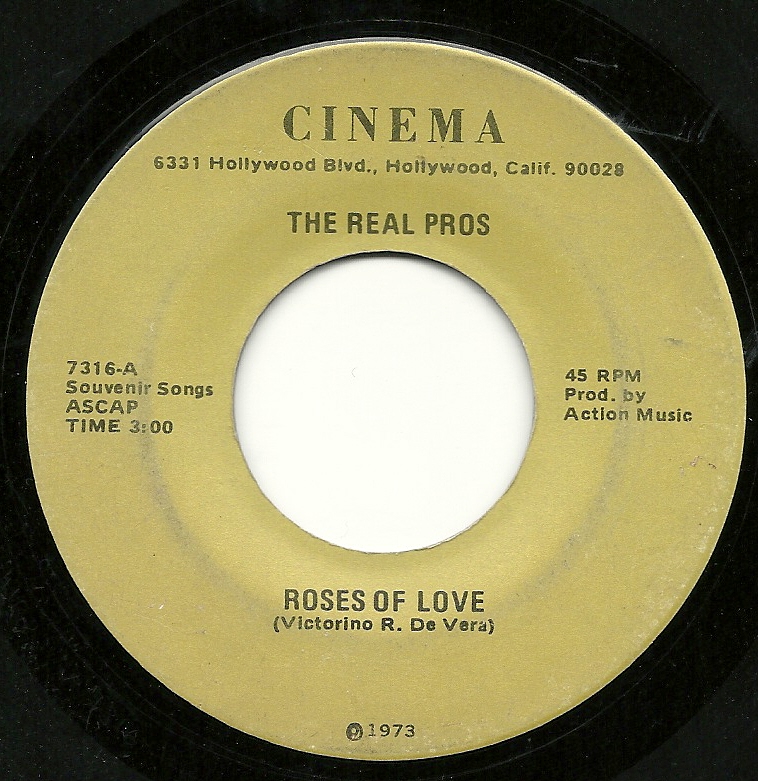
Today, let's hear it for The Real Pros, that anonymous gathering of song-poem professionals pulled from whoever happened to be available for the sessions that week. And this week's feature actually pairs up two very different sides of the "group". On the A-side, we have that earliest of Cinema/Real Pros sound, the one-man-band with the home studio, play-it-yourself rhythm and chord organ, on a number called "Roses of Love".

The lyrics here strike me as staggeringly unmusical and stupifyingly non-sensensical at times. Is there a way to fit "If I'm only a poet, every poem I compose will be from your name" into a melody, ANY melody, and make it work? Also notice that the statements are "if I'm only a king" and "if I'm only a poet", and not "if I was...", which would be the correct opening, given that the writer is contrasting these things with what he is, which is, wait for it "only me".

And here's where it really falls apart for me, because being 'only him', he is telling his love that the only thing he can offer is something free, which he then identifies as.... Roses? I've bought Roses - I even once worked in a flower store. And I know this: Roses aren't free. And I haven't even gotten to the moment when the singer - who sort of reminds me of Dick Kent, although that's not who it is - starts talking, something that's usually the sign of lyrics that were too clunky to fit to music at all.

Download: The Real Pros - Roses of Love
Play:

Curiously, the flip side, "Broken Hearted" clearly features a different song-poem factory sound, that of the Preview label, specifically the Preview of Rodd Keith. This is a VERY late-era Rodd offering, dated 1973, and as my friend Stu has pointed out, it seems likely that Rodd took some of his Preview backing tracks with him, as he would certainly have been at MSR by this point.

This is Rodd in his C and W guise, with the hick edge to his voice, and certainly the better of the two songs and performances.

Download: The Real Pros - Broken Hearted
Play:


Thursday, September 13, 2012

A Halmark Record Like Few Others


My inclination was actually to title today's presentation "A Halmark Record Like No Other", but since I haven't seen every Halmark record, I'm not going to make that assumption. But I know I haven't seen another one like this. What we have hear is clearly a vanity recording of a gentleman singing his own song, accompanied (very likely doing it himself) by a single guitar.

To hear any "real live musician" on a Halmark track - Halmark being the home of the canned, discarded backing track over which the house singers would sing the lyricists' offering - is startling. It's also jolly fun to see this solo performance carry the credit "High Fidelity Vocal and Orchestra directed by Ted Rosen".

As to the fun to be had listening to Daniel L. Johnson singing and playing his song "Backing Up in Boston", well, that fun is certainly there to be had, but I'll leave the discovery thereof to the listener!

Download: Daniel Johnson - Backing Up in Boston
Play:

For the flip side, it's back to the Halmark salt mines, for a tried and true backing track, one I've heard on at least a dozen of the label's releases, over which we have the typically shrill stylings of house tenor Jack Kim. I will admit that I have listened to "Time That I Take Out" three times today, and while I recognize that the lyricist (the wonderfully named Preston Prescott) is expressing his reasons for leaving his relationship, his wordy expressiveness leaves me gasping at times, unable to quite figure out the specific meaning of some of his phrases, including the one in the title.

Oh, and technically speaking, Ted Rosen didn't direct the High Fidelity Orchestra heard on this side, either.

Download: Jack Kim - Time That I Take Out
Play:


Thursday, September 06, 2012

Space Age Babes I Have Known


Some days, it must have been downright fun to be working at a song-poem company. Imagine Gene Merlino (AKA Marshall) picking up the music for today's offering, and seeing the title, "Minnie the Space Age Babe". Listening to the arrangement and performance, it's clear to me that this was a title that inspired the creative people behind the scenes to do something worthy of that title. The composition and arrangement here fairly scream out "Rodd Keith" to me, and everyone involved sounds happy to be there.

Download: Gene Marshall - Minnie the Space Age Babe
Play:

I can say exactly none of the same things I just wrote about "Minnie" with regard to the flip side, "What is a Man?", one of those painfully earnest, ridiculously ponderous lyrics, and one which got the setting and performance that those lyrics required. The results are, in my opinion, just deadly.

Download: Gene Marshall - What Is a Man?
Play:


Wednesday, August 29, 2012

Red Hot Mama


Okay, right off the bat, let me acknowledge that today's record is beat to hell, and that you'll have to listen past some righteously awful surface noise. But c'mon, it's Norm! With a couple of winning tracks, ones I find quite worthy of suffering through the crackle and pop of an either over-loved or criminally mistreated and neglected 45.

First up, "Red Hot Mama". This one has slow, soulful beat, some really nice piano, and a typically wonderful vocal from Norm. There's even an actual guitar solo, something I don't remember hearing on many Sterling records. And another thing that makes this one unusual: I would also argue that this is the rare Sterling song-poem where the music reflects then-current (1971 or so) trends in music - elements of the backing track here reminds me of more than a few soul-pop records of the 1970-71 period. Stick around for the ridiculous repeating lyrics at the end of the record.

Download: Norm Burns and the Five Stars - Red Hot Mama
Play:

On to side two, "Love Ya Honey". After a catchy, off-kilter instrumental introduction, we are treated to another superb vocal from Norm (who is probably one of my two favorite song-poem singers, along with Cara Stewart). Here, he makes magic with a really corny and repetitive lyric, and the arrangement also works wonders with what could have easily (in the hands of lesser companies by a stale performers) been rote and dull - I'm especially fond of the section from 1:50  to 2:05, where it sure sounds like there's been an extra beat or two thrown in, yet a careful counting shows that it never goes out of 4/4 time.

Download: Norm Burns and the Five Stars - Love Ya Honey
Play:


Thursday, August 23, 2012

Sonny and the Stones


Ah, yes, "It's All Over Now". Is there a better record from the Stones' earliest period? Keith's guitar break - well, I guess you some love it and some hate it, but Charlie's drumming is propulsive and the whole band just cooks. And Sonny Marcell's lead vocal is.... wait, Sonny Marcell? One of the many names of song-poem Zelig Sammy Marshall? Are we talking about the same song? The same band? Er... I guess not. This "It's All Over Now" is another early '60's Globe factory special, in this case a performance that wouldn't sound out of place on the stage of a Holiday Inn lounge, released on the tiny Jabar imprint. Let's listen in!

Download: Sonny Marcell - It's All Over Now
Play:

And what do you have left when "It's All Over"? Well, leftovers, and to sing the excessively goopy song, "Left Over Love", again we have Sammy "Sonny Marcell" Marshall:

Download: Sonny Marcell - Left Over Love
Play:


Wednesday, August 15, 2012

In the Garage with Tin Pan Alley

First, I want to mention that I recently wrote a post at WFMU's blog about a record which appears to have some song-poem connections, although it may or may not be a song-poem. It can be found here. And now, on with the countdown!


How do YOU spell the words that make up the first line of a classic children's rhyme, the ones which come before "catch a tiger by the toe"? A quick web search finds only a few minor disagreements - Virtually everyone agrees on a combination of some of the following "Eeny/Eenie, Meeny/Meenie, Miny/Miney/Minie, Mo/Moe". For Joyce and Lawrence Herren, however (and virtually no one else in the world, as far as Yahoo and Google appear to be concerned), the phrase is spelled "Enny Minnie Mighty Moe". Fascinatingly, at one point Joyce recorded the song herself, and it has shown up on at least one compilation, and can be heard in the middle of this youtube posting

The song isn't much, but that's a winning performance in my book. For some reason, the authors then handed off their composition to Mike Thomas, of Tin Pan Alley, who recorded it with the same collection of Garage Rock wannabes that show up on many of his records. The results were as predictable as every other TPA record of the era - minimalist backing and a lightweight vocal from Mike, which gives way to a barely competent (or perhaps you favor the phrase "borderline incompetent") garage style solo section.

The question remains - is this a song-poem as strictly defined or a vanity recording. Did the Herren's write this song, words and music, and then commission Tin Pan Alley to record it, or did Tin Pan Alley put music to their words, and only then, perhaps not satisfied with TPA's performance, Joyce recorded it herself. I would like to think that's more likely than them not liking Joyce's own inspired rendition, and seeking to improve it via TPA....

Play:  

On the flip side, we have a tragic story. It's of a young person who seemingly threw away everything in life, and took a plane to San Francisco, on the hopes on connecting with the sweetheart who lived there. As you'll hear, if you can stomach the rather tuneless song that long (and get through lines like "I dreamed that waiting at airport"), it didn't quite work out as planned. Stick around after he tells his story for more Guitar God in training moments.

Play:  


Thursday, August 09, 2012

Rodd Keith - Country Bumpkin


I always get a kick out of Rodd Keith trying to sound like a hick, on the most countrified of his releases. And here's a prime example, a rather wonderful piece of ridiculous backwoods-speak set to music, titled "Rope Me a Good Looker". 

Play:  

I always wonder what the writer would think, upon hearing Rodd in hayseed mode, then putting on the other side, and hearing what was clearly the same singer (and billed as such) demonstrating, via a straightforward MOR performance, that his singing on the country number was less than honest. Such would probably have been the case here, as the flip side is the completely mainstream (and desperately dull) "It Only Takes a Moment to Fall in Love", with Rodd in unctuous, lounge-singer mode:

Download; Rodd Keith and the Raindrops - It Only Takes a Moment to Fall in Love
Play


Thursday, August 02, 2012

Norridge Mayhams Last Gasp


Within the greater song-poem world, Norridge Mayhams has always been something of a hero to me. Not only did he do it all himself, he often did it quite well. In a career lasting over 40 years, he went from Gospel to Raunchy Blues, from Latin-tinged idiosyncratic records to straight ahead pop and rock and roll. He wrote both the words and music for most of his songs, and in the early days (through at least the late '50's) even sang on several of his records, in addition to releasing them on at least three of his own record labels. He even wrote a hit song, "We'll Build a Bungalow". One of his records, the earlier of at least two versions of his song "Mary Ann McCarthy", remains one of my three or four favorite song-poem records.

So it was with considerable sadness that I listened for the first time to today's record, which is among the last that Mayhams produced. As described at the AS/PMA site linked above, shortly after his final triumph, the 1976 double album capturing a good 15 years worth of his best material, Mayham's life began to fall apart. As heard here, just three years later (in 1979), not only has he moved on from some truly wonderful styles of music, and into the most mindless version of disco possible, but he is also expressing his grief at the death of his dear wife, Shirley. The words are actually touchingly sweet, but when paired with the stupid beat, the obnoxious synth, the out of town guitar and single trumpet notes (not to mention the crappy production), the effect is fairly depressing. My guess is that it is Norridge Mayhams himself singing here. If so, it's with (in what was probably his 70's) a shadow of the life-affirming voice from his records of two and three decades earlier.

Download: Seaboard Coastliners - Sweet Shirley 
Play:

"Sweet Shirley" was actually the b-side. The less said about the truly mindless a-side, "Dance Dance All Night Long", the better, but here it is:

Download: Seaboard Coastliners - Dance Dance All Night Long
Play:

By the way, at least one further Mayhams record may have been released, if the order suggested at AS/PMA is accurate, that one featuring what may be this same recording of "Dance Dance" along with a disco remake of "We'll Build a Bungalow"


Wednesday, July 25, 2012

WHAT A FIND!!!


Today's feature poses a question I'd never considered before: Did the Lee Hudson Song-Poem Experience Factory (basically Lee himself, with Cara Stewart and from time to time, Jeff Reynolds) work not only on the classic song-poem model, but also engage in some vanity work - recording completely developed songs by either amateur or established songwriters?

I ask because today's record, which I consider a hell of a find, seems too "finished", too self-aware and too professional a set of compositions for all but the highest end of the song-poem field, if that. It's a production, particularly the b-side, which rivals or exceeds all but the best thought out efforts of Rodd Keith, and certainly beyond anything I would have expected from Lee Hudson. Then there's the fact that it's on the Melodia label, which I've been previously unfamiliar with.

Not only that, but both songs are written by a team (the same team on both sides), with one of the two claiming publishing rights (this same team shows up on one other song listed in the AS/PMA archives). On the other hand, it has all the hallmarks of a Lee Hudson production, not to mention his two singers, so at least on that score it belongs here.

Let's start with the A-side, "Bee-Boppa-Roo". I listened to this one first, and although I thought it more polished and thought out than most song-poems, I still thought it probably fit into that world. It does, however, have unusually clever lyrics, along with the typically bopping Hudson backing, with wonderful guitar fills and peppy bassline:

Play:  

Give a listen, though, to what's on the B-side. "Doc Nut" is a different animal altogether - a genuinely funny, clever and extremely well constructed novelty record. The Hudson sound is still there, this time with accordion, and multiple Cara's on backing vocal. But those lyrics! The comic voice done by Jeff Reynolds! And that's on top of the downright lovely and winking Cara Stewart lead vocal!

Whatever its provenance, this one - were there still song-poem compilations being released - would certainly be a prime candidate for release on a CD compilation.

Download: Cara Stewart and Jeff Reynolds with Lee Hudson's Orchestra - Doc Nut
Play:  


Wednesday, July 18, 2012

A Missing Link?


Today's record is among the most intriguing and mysterious to me of any that I've recently posted.

Some of you will be aware of the career of Sandy Stanton, who I've rhapsodized about here, and more extensively, at WFMU. Many of his 1950's Fable releases are highlights of my collection.

After Fable made the trip from curious but often effective rockabilly into all manner of novelty records and then more solidly into the song-poem arena, Stanton has been said to have closed up shop at Fable, bought a Chamberlin, discovered Rodd Keith and started the Film City family of labels, with Rodd (as Rod Rogers) his star attraction on a wonderland of records and label designs often featuring a Chamberlin masquerading as some sort of band whose name would show up in quotes, often with "strings" being the last word of the band name.

Here's the curious part: All but a handful of Fable releases are known to have been released before the end of the 1950's, with label numbers under the four-digit mark, and Film City appears to have started up in the early 1960's. Although there is some overlap in time and billing style - AS/PMA lists four Fable records with higher numbers, all of which have the Stanton fake band names as part of the billing - I'd never heard any of them before getting this record.

And the differences between the two labels couldn't be more severe - Fable records generally feature real bands, often with a driving rock beat or solid country sound, and prominent guitars. Film City records are almost always one-man band productions, with not a single "real" instrument heard. I've always been amazed that the same person was behind both labels, and that he seemingly made the switch from one style to the other, virtually overnight.

Then comes this record, which features a modified Film City sound on the Fable imprint. It has a label number of 1250, a Fable Label design nothing like the one used in the '50's, a Stantonesque "Rockin' Strings" band name, and a singer name which turns up on no other song-poem that I'm aware of ("Bob Rogers"). It also features what sounds like an some sort of early keyboard instrument, but not like any Chamberlin record I've ever heard. The keyboard player's style certainly convinces me that it's Rodd Keith, but as to the singers.... well, the "Bob Rogers" on the first side might be Rodd Keith, but it only sort of sounds like him to me. I'm almost sure that the "Bob Rogers" on the second side is Frank Perry.

This record can't even come from the earliest days of Film City, nor right after the last batch of more typical Fable records. The ZIP code on the label demonstrates that it comes from at least 1963. The more sophisticated keyboard sound makes me suspect it's from at least a few years after that date, as well.

So did Stanton temporarily revive Fable, to release a few records, at least four years after largely shutting it down, and have Rodd Keith put together two songs (each by the same two writers), using a higher quality keyboard of some sort than the ones used on Film City records? And is that Rodd singing on the A-Side? I am curious to think what any of you reading this may think. Here is the A-side, "Rock and Roll Star".

Play:  

And the somewhat odder b-side, "Rock and Roll Date":

Play:  


Wednesday, July 11, 2012

Uncatchy Song Title Day


Time is short this week, but as always, I have at least enough of it to offer up two more slices of song-poemery. Today we have two songs featuring clunky, wordy titles, of a type unlikely to catch on with anyone. This 1974 release is on Cinema, which means that the credited artist is The Real Pros, which in this case means the same old anonymous backing band, fronted by two stalwarts of the field. First up, Bobbi Blake singing the "Let's Shake Hands With Our Neighbors":

Play:  

The flip side has Dick Kent taking over lead vocal duties, on a charming number whose title also could definitely have used some editing, "In the Deepest Depths of Lonesome":

Download: The Real Pros - In the Deepest Depths of Lonesome
Play: